


WHO IS MICHAEL BURRY?
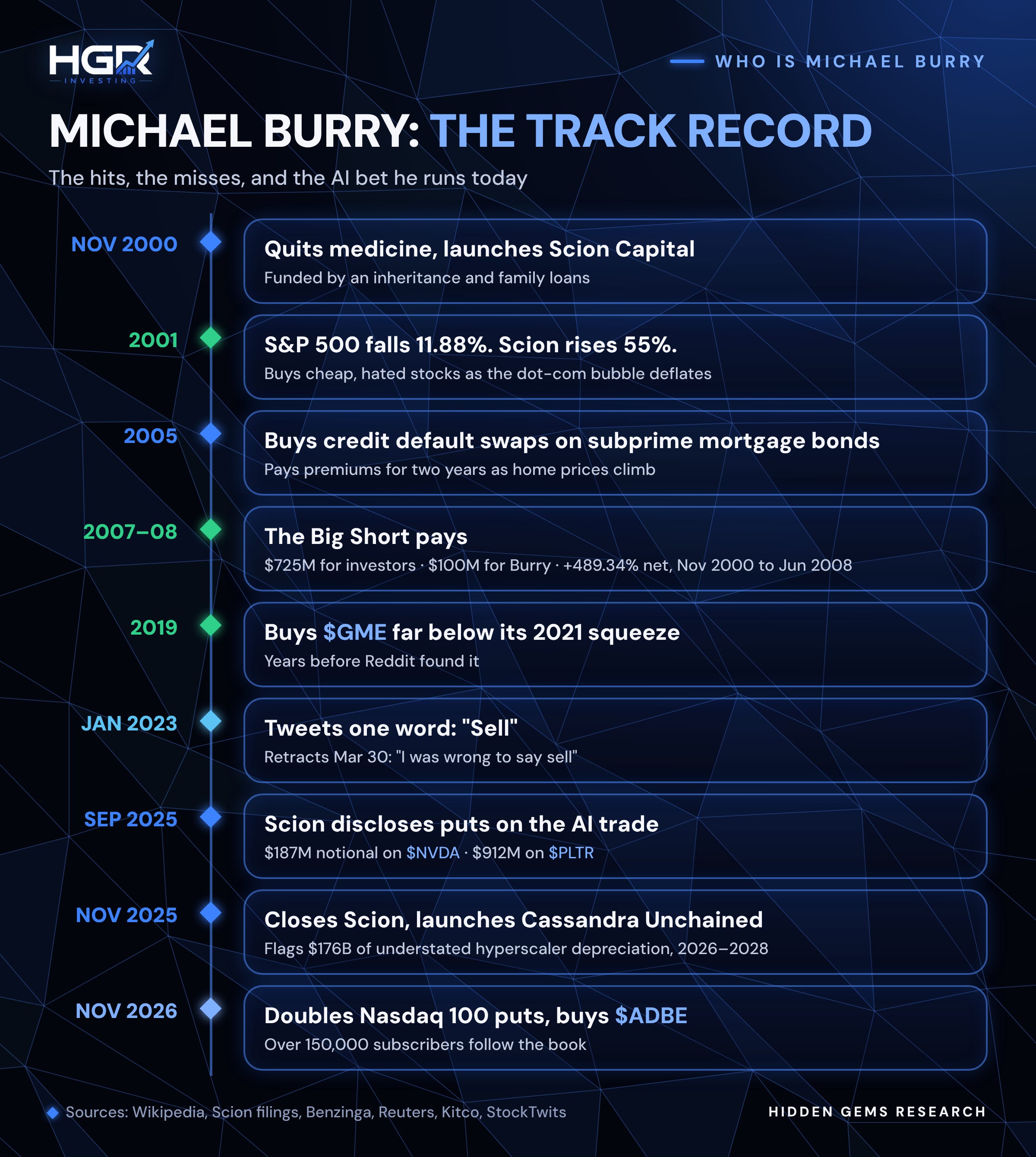
Most people know Michael Burry as the guy Christian Bale played in The Big Short, but his true origin started in the hospital. Burry trained as a doctor and worked as a Stanford neurology resident while he wrote about value stocks on internet message boards at night. His posts drew enough attention that he quit medicine and launched Scion Capital in November 2000 with an inheritance and loans from his family. He made his name right away: in 2001 the S&P 500 fell 11.88% and Scion rose 55%, because Burry bought cheap, hated companies while the dot-com crowd dumped everything. Then came the call that made him famous. In 2005 he read through mortgage bond prospectuses and concluded the U.S. housing market would collapse once teaser rates on subprime loans reset. Wall Street had no product to bet against mortgages, so he asked the banks to build one, bought credit default swaps on subprime mortgage bonds, and paid premiums on them for two years while home prices kept climbing. His own investors revolted and some tried to pull their money. Then 2007 and 2008 arrived and the trade paid. Scion made $725 million for its investors, Burry made $100 million for himself, and the fund returned 489.34% net of fees from November 2000 through June 2008 while the S&P 500 finished lower over the same stretch.
HE DOESN’T ALWAYS WIN
I’m not going to pretend the man runs a perfect record. Burry bought $GME in 2019 at a deep discount, well before Reddit found it, and made millions. He also flagged a market crash in 2019 that never came. On January 31, 2023 he tweeted one word: “Sell.” The Nasdaq had its best first half in 40 years. On March 30 he wrote, “I was wrong to say sell.”
Burry’s track record in indicative of a couple things. He reads balance sheets better than almost anyone alive. He times markets about as well as the rest of us. Being early and being wrong look identical while you hold the position. I know I’ve gone through similar stretches, highs and lows, in my time investing too.
WHY HIS WORD STILL MATTERS IN 2026
Burry went public against the AI trade in the fall of 2025. As of September 30, 2025, Scion disclosed put options worth about $187 million in notional value against $NVDA and $912 million against $PLTR. Palantir CEO Alex Karp called the bets “super weird.”
Then Burry made an accounting argument nobody else on Wall Street wanted to make. Hyperscalers buy Nvidia chips on a two to three year product cycle, yet they extended the useful life of their servers on paper to five and six years. That stretches out depreciation and inflates reported earnings. Burry estimated the industry would understate depreciation by $176 billion between 2026 and 2028, with Oracle overstating 2028 earnings by 26.9% and Meta by 20.8%.
A year later, $NVDA trades 38% below its October high, and Burry just closed his Oracle puts after a long run of downside volatility. You don’t have to agree with him. You do have to read him, because he does the forensic accounting work most analysts skip. Over 150,000 people now pay to read his Substack.
WHY THIS MARKET IS BURRY’S MARKET
Look at Burry’s two great runs. He beat the market in 2001 while the dot-com bubble deflated, and he made his fortune in 2007 and 2008 when cheap credit got abused by buyers who couldn’t pay it back. Both times, the crowd sat on one crowded trade and ignored the cracks in the financing underneath it. Today’s market carries pieces of both.
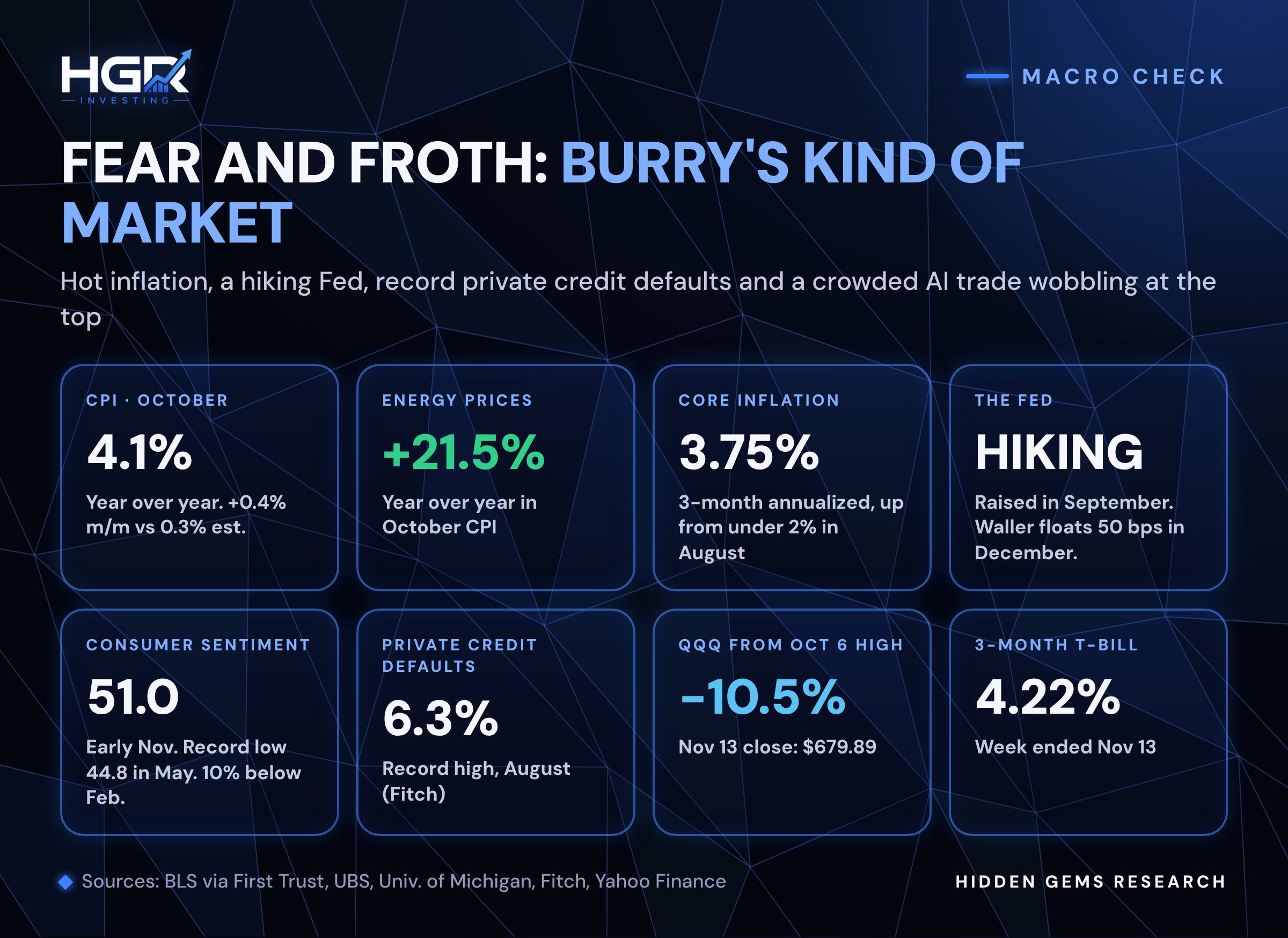
Start with inflation and rates. October CPI rose 0.4% against a 0.3% forecast, lifting annual inflation to 4.1%, with energy up 21.5% on the year. The Fed raised rates in September, and after the October print Governor Christopher Waller floated a 50 basis point hike for December. Three-month annualized core inflation ran at 3.75%, up from under 2% in August. A Fed that hikes into a slowing consumer puts pressure on every stretched valuation in the market.
Then look at the consumer. The University of Michigan sentiment index hit a record low of 44.8 in May as supply disruptions in the Strait of Hormuz pushed gas prices higher. It bounced to 51.0 in early November and still sits 10% below its February level. Burry titled a November 2 post “Opportunity in the Worst-Ever Year for Consumer Sentiment,” and his long book shows it: $LULU, $SFM, $BIRK, $DECK and Build-A-Bear all sit in his portfolio.
Then look at credit. Fitch put the U.S. private credit default rate at a record 6.3% in August, and life insurers keep adding private credit to their balance sheets. That looks like 2007 to Burry, and he positioned for it with puts on $MET.
Last, look at the crowd. QQQ closed November 13 down 10.5% from its October 6 high. Jensen Huang resigned as Nvidia’s CEO. Hot inflation, a hiking Fed, record private credit defaults and a crowded AI trade wobbling at the top: that mix of fear and froth gives Burry his best setups. When everyone agrees, he finds the holes. When everyone panics, he buys the cash flows. I want his work in front of me while the setup forms, before the headlines catch up.
So I read it. Then I checked his math.
THE BURRY FORMULA
Michael Burry stopped filing 13Fs when he deregistered Scion Asset Management in November 2025. He launched Cassandra Unchained on Substack on November 23 that year, and he now posts his trades there in close to real time. That gives us something we never had in the Scion days. We can see his book as he moves it.
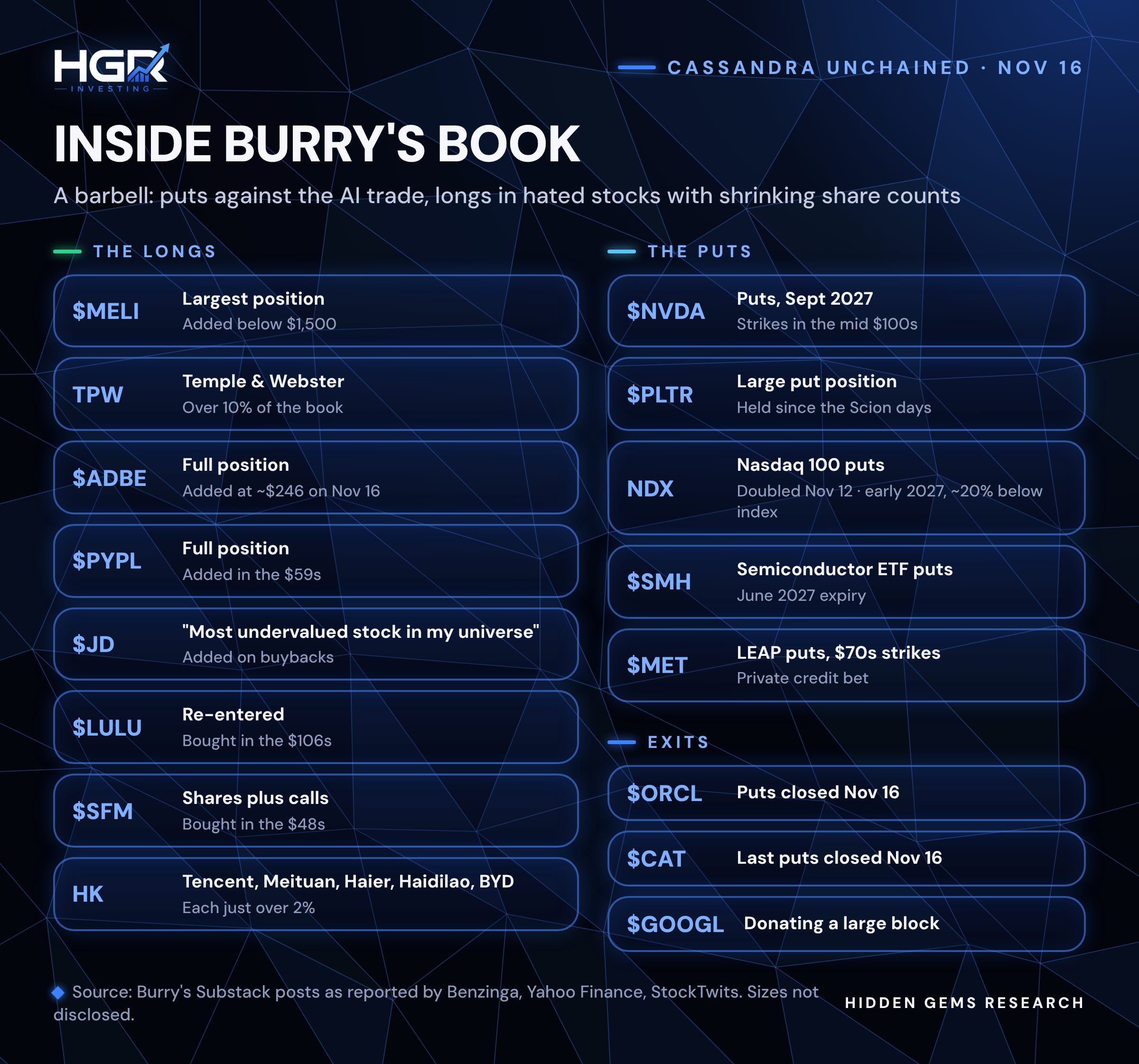
He moved it a lot this month. On November 10 he started a recurring portfolio rundown he calls Portpourri. On November 12 he doubled his Nasdaq 100 put position after the index bounced off 27,000, adding early 2027 puts struck about 20% below the index level. On November 16 he bought more $ADBE at about $246 and called it a full position, added to $MELI, and closed his Oracle puts and his last Caterpillar puts.
The book runs as a barbell. On one side sits a stack of puts against the AI trade: $NVDA, $PLTR, the VanEck Semiconductor ETF ($SMH), the Nasdaq 100, plus $MET as a private credit bet. On the other side sits a long book of beaten-down names with shrinking share counts: $MELI, Temple & Webster, $ADBE, $PYPL, $JD, $LULU, $SFM, a Hong Kong basket and more.
I don’t follow anybody blind. Burry included. So I pulled the latest earnings, the valuation multiples and the price action on his biggest positions and sorted them into two piles. My scorecard below uses prices as of midday Wednesday, November 18.
WHERE I AGREE: $ADBE
This is the best trade in Burry’s book right now.
Adobe trades at $227.52 as I write this. Burry bought his last tranche at $246, so he sits about 7.5% underwater on that add. The market has spent all of 2026 pricing $ADBE as an AI casualty. The stock is down about 30% on the year and Wells Fargo and HSBC both downgraded it in October.
Now look at what the business did. Fiscal Q3 revenue hit a record $6.76 billion, up 13% year over year. Subscription revenue grew 14%. Management raised full-year revenue and earnings targets. AI-first annual recurring revenue grew more than 150%.
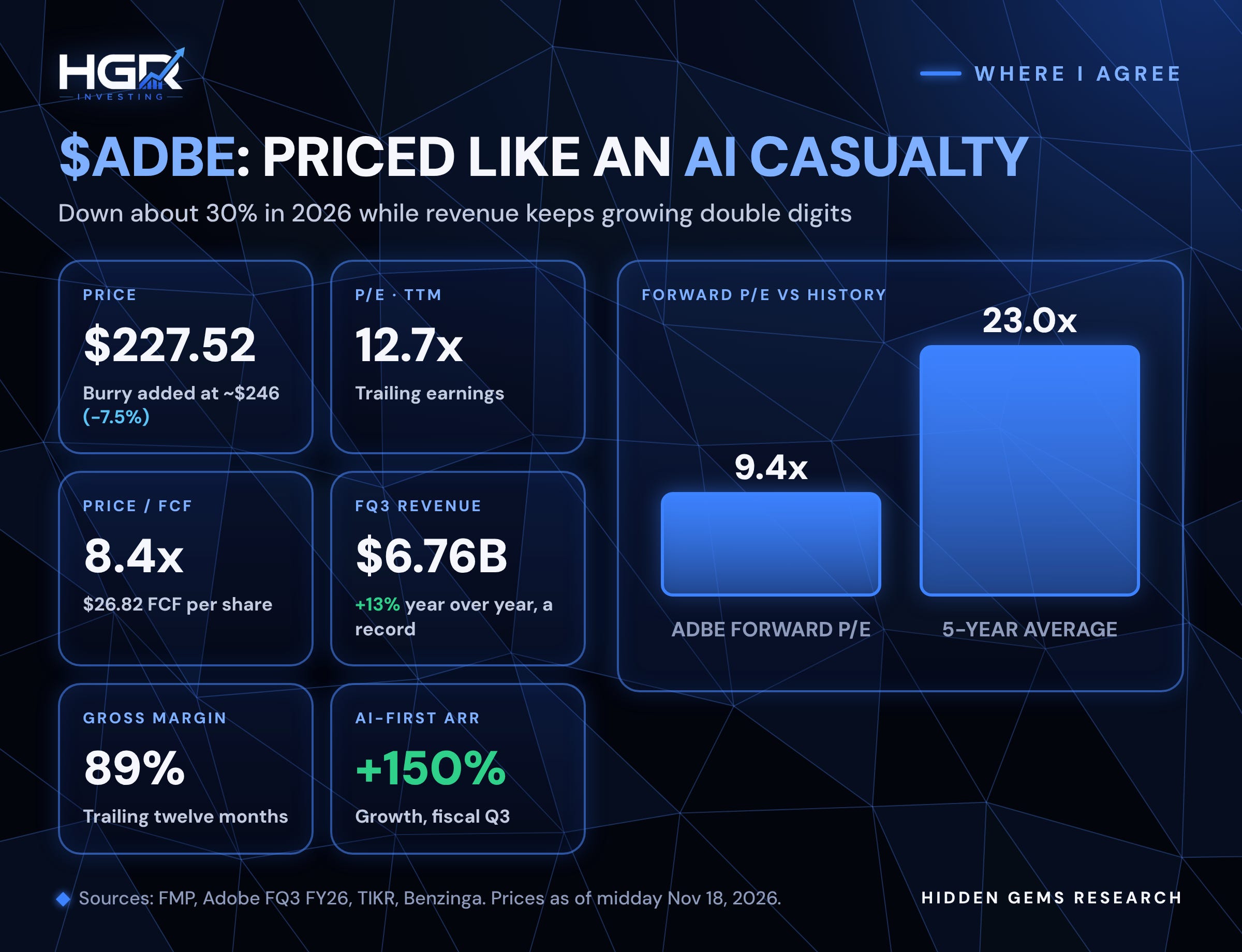
The valuation is the part that gets me. On trailing numbers from FMP, $ADBE trades at 12.7x earnings and 8.4x free cash flow, with an 89% gross margin and $26.82 of free cash flow per share. Analysts put it at 9.4x forward earnings against a five-year average of 23x. You are paying a value-stock multiple for a software company that still grows double digits.
Burry’s argument holds up. Free clones of Photoshop have existed for decades, and Adobe grew revenue 10% or more in each of the last four years anyway. He points to file formats, the installed base, enterprise contracts and security as the moat, and he names the two things to watch: the cost of the third-party models Adobe sells inside its apps, and the growth rate of new subscriptions.
MY TAKE: I agree. At 8x free cash flow, Adobe only needs to stay alive to work. It doesn’t need to win AI.
WHERE I COULD BE WRONG: A CEO transition weighs on the stock, and revenue growth is expected to slow toward 9% in fiscal 2027 and 8% in fiscal 2028. If net new subscriptions roll over, the market will keep treating $ADBE as a melting ice cube no matter how cheap it gets.
Everything above is free. The rest of my scorecard, including the Burry bet I think will lose money from here and the exact $PLTR levels where I flip from bear to buyer, sits below.
