


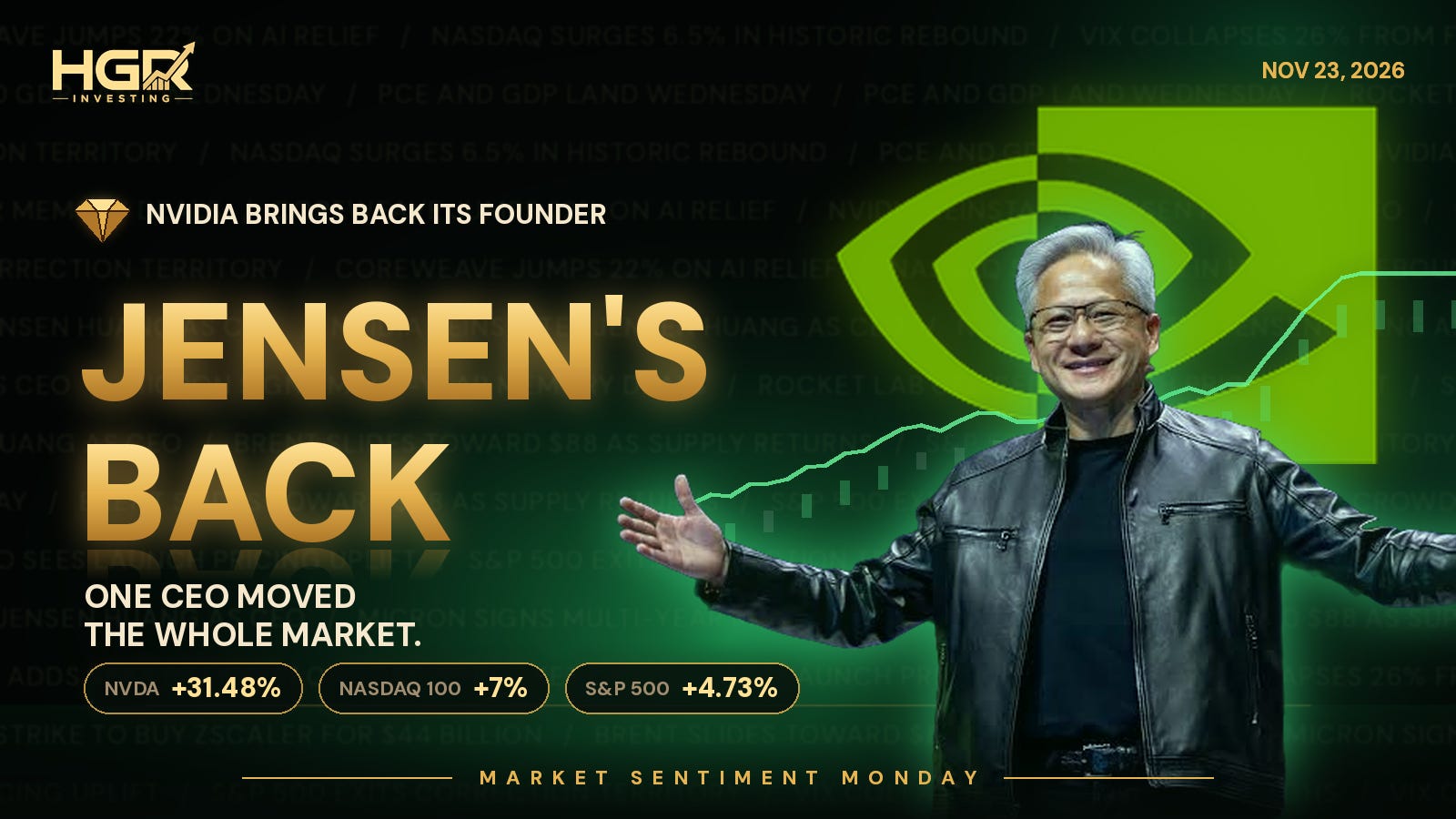
Happy Monday, everyone and what a Monday it was, with the Nasdaq index rallying over 7% in ONE move. Why you may ask? It all started eleven days ago when Nvidia pushed out its founder. This morning the board brought him back, and the market ripped higher to erase Friday’s astronomical losses. Below you get the numbers, why one personnel decision moving this much money alarms me, and where our positions stand heading into a three-and-a-half-day Thanksgiving week.
THE SNAPSHOT
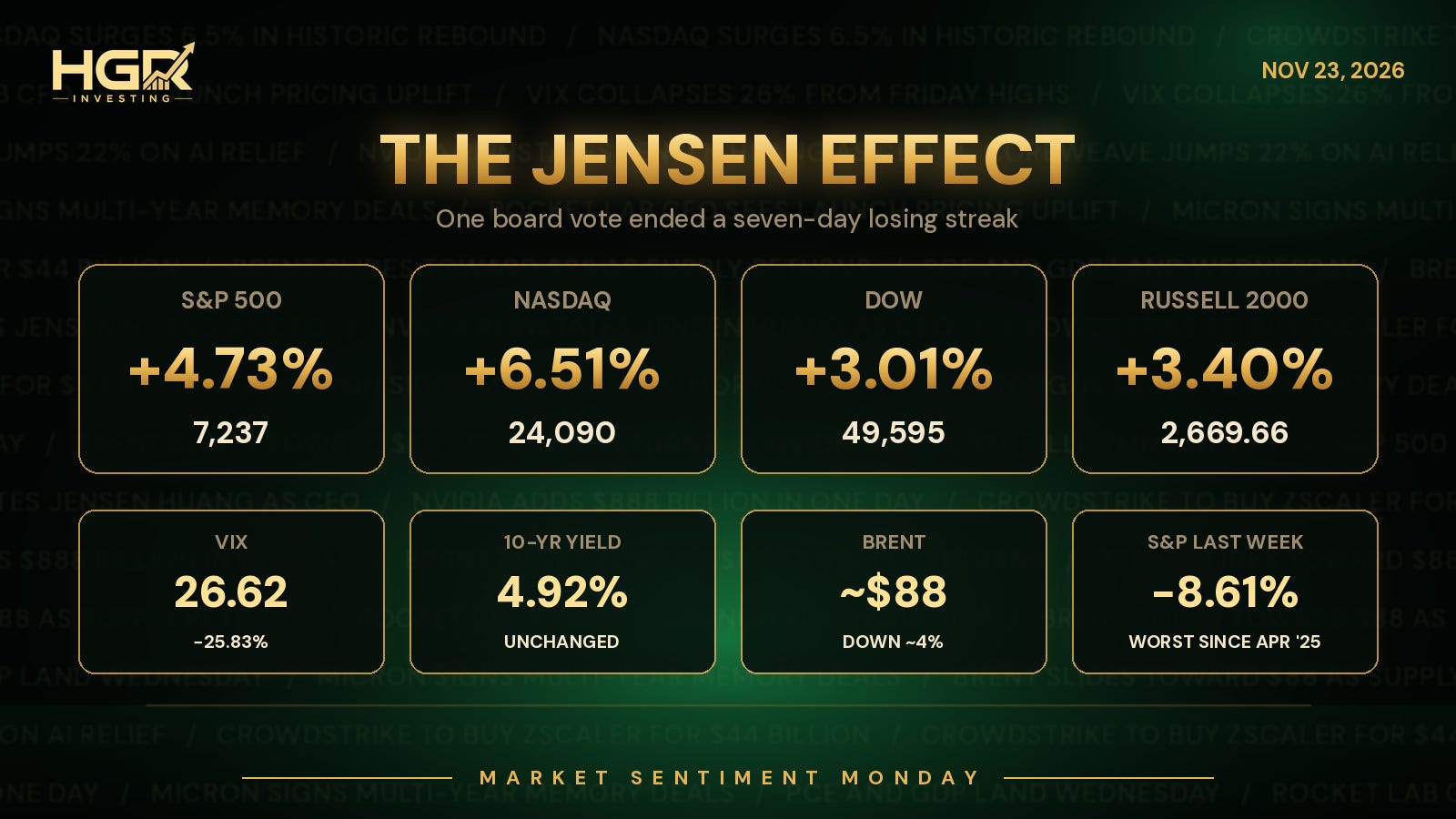
The S&P 500 gained 4.73% to close at 7,237. The Nasdaq Composite ran 6.51% to 24,090, and the Nasdaq 100 tracker QQQ closed up 7.00%. The Dow added 1,448 points, or 3.01%, to 49,595. The Russell 2000 rose 3.40% to 2,669.66. The rally snapped a seven-session losing streak and pulled the S&P out of correction territory. Last week the S&P fell 8.61% and the Nasdaq fell 10.02%. Friday alone cost the S&P 3.7% and left it at 6,910, its first close under 7,000 since mid-April. The VIX fell 25.83% to 26.62 after spiking above 40 on Friday. Traders bought less protection today, but a VIX in the high 20s tells you they still expect big swings.
THE PULSE
Nvidia’s full board voted to reinstate Jensen Huang as president and CEO, effective today. NVDA closed up 31.48% at $165.05. Huang resigned on November 12 after reports of two affairs, one with a woman suspected of spying for China. On November 17 the board said it did not intend to bring him back. Six days later it reversed itself. President Trump told CNBC he had talked with board members about Huang’s return. Investors added about $888 billion to Nvidia in one session, the largest one-day gain in market value on record.
One man’s job title moved the entire market. This should alarm you. Nvidia’s weight in the S&P 500 hit about 8% in September, the highest single-stock concentration in more than 50 years. Semiconductors went from about 5% of the index in 2020 to about 19.7% by mid-2026. When a board’s personnel call adds close to a trillion dollars by lunchtime, your index fund carries single-person risk you never signed up for. Look at the timing too. On November 12, the day Huang left, the S&P absorbed a 14.3% intraday drop in Nvidia and finished down less than half a percent. Today the reversal lit up chips, memory, cloud, power and optics all at once. Traders sold Huang’s exit as one stock’s problem and bought his return as the whole AI trade’s rescue.
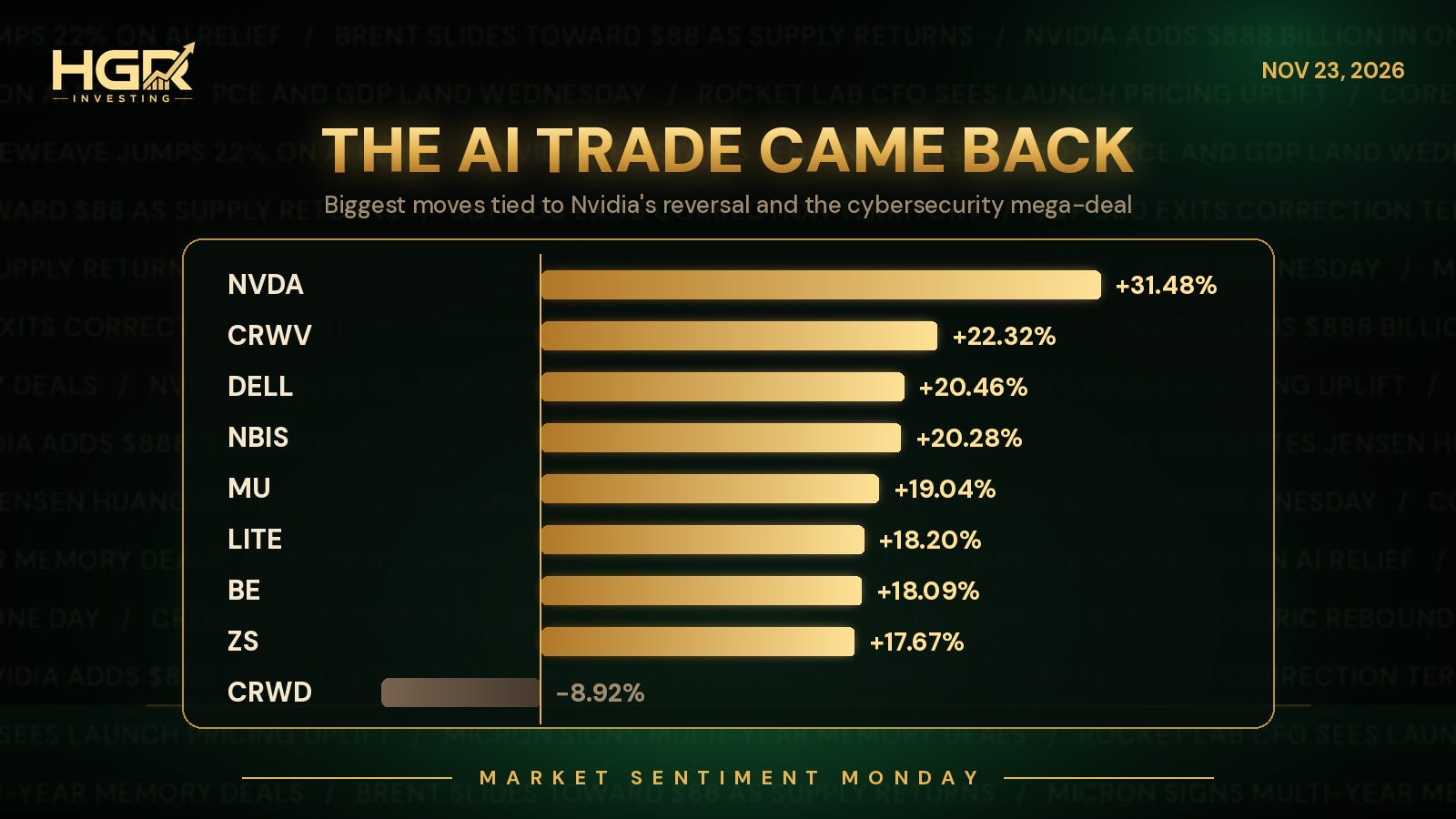
The AI complex followed Nvidia. CoreWeave gained 22.32%, Dell 20.46%, Nebius 20.28%, Micron 19.04%, Lumentum 18.20% and Bloom Energy 18.09%. Micron also announced new multi-year memory supply agreements. Oracle rose 12.3%, Tesla 11.5% and Palantir 11.1%.
Huang’s return settles Nvidia’s leadership. The selloff started with a different question: can AI customers earn a return on what they spend on infrastructure? Today’s rally didn’t answer it, and Wednesday’s data will test whether buyers stick around. The Iran war is still on and inflation is steady on the rise. The macro environment is still in trouble and can’t be saved by NVDA 0.00%↑ led rally.
SECTOR ROTATION
Buyers went straight back to the most beaten-up AI trades. Chips, memory, neoclouds, optical networking and data-center power led. Megacap software lagged. Microsoft gained 1.6% and Apple 1.9%, a fraction of the Nasdaq’s move.
Cybersecurity split in two. CrowdStrike agreed to buy Zscaler in an all-stock deal valued at $44 billion. Zscaler jumped 17.67% and CrowdStrike fell 8.92%, so investors decided the buyer is overpaying.
Small caps rallied and still trailed. The Russell’s 3.40% gain lagged the S&P’s 4.73% and the Nasdaq’s 6.51%. Big tech carries far more weight in the large-cap indexes, so a day driven by Nvidia favors them. Space stood out. Rocket Lab gained 9% after its CFO said he expects Electron launch prices to rise within six to nine months, with SpaceX’s Falcon 9 booked through late 2028 or early 2029.
MACRO AND GEOPOLITICS
Bond traders shrugged. The 10-year Treasury yield held at 4.92% and the 2-year at 4.63%. The economic data came in soft. The November flash composite PMI declined on weaker-than-expected services, and the Chicago Fed National Activity Index slipped to -0.06 for October. The dollar index hit a 19-month high near 104.30.
Oil kept falling. Brent slid almost 4% to around $88 and WTI fell to around $80. Tankers are moving crude through the Strait of Hormuz at close to pre-war levels again, and traders now price a surplus instead of a shortage, with the Iran war and Houthi attacks on shipping still in the headlines. Cheaper oil eases cost pressure on smaller domestic companies. Gold traded near $3,648, and Bitcoin climbed back to the low $60,000s after falling toward $55,000 over the weekend.
Wednesday decides the week. At 8:30 a.m. ET we get October PCE, the second estimate of third-quarter GDP, durable goods and jobless claims, and the Fed releases its Beige Book that afternoon. Economists expect headline PCE at 3.8% year over year, up from 3.6%, and core PCE at 3.2%, up from 3.1%. They expect GDP at 3.5% annualized. Strong growth with rising inflation keeps a Fed rate hike on the table, and the Fed meets again in two weeks. Dell reports Tuesday after the close, and Deere, Analog Devices, HP Enterprise and Best Buy report this week too. Markets close Thursday for Thanksgiving and shut at 1 p.m. ET on Friday. Thin holiday volume can exaggerate moves in either direction.
For the full brief and specific trade set ups in the HGR Watchlist become a premium member today!
