


SpaceX posted the best quarter in its history last night. Most of the space stocks below it trade 65% to 76% under their highs. I spent today in the filings, the earnings calls, and the backlog numbers to find which of those discounts the market got wrong.
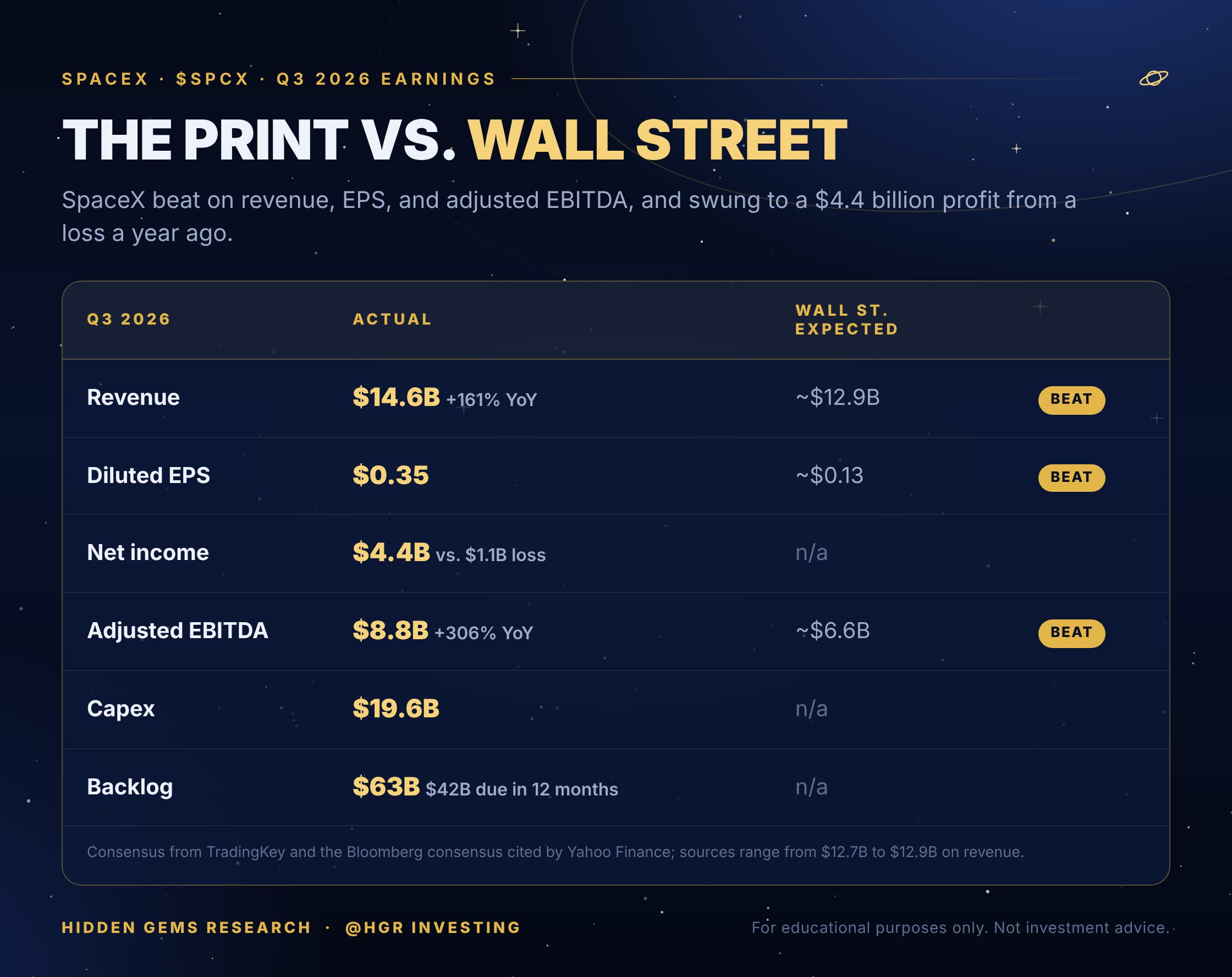
SpaceX reported $14.6 billion in third-quarter revenue, up 161% from a year ago, against about $12.9 billion expected. The stock jumped more than 9% after the bell and traded near $160 this morning, a $2.17 trillion company.
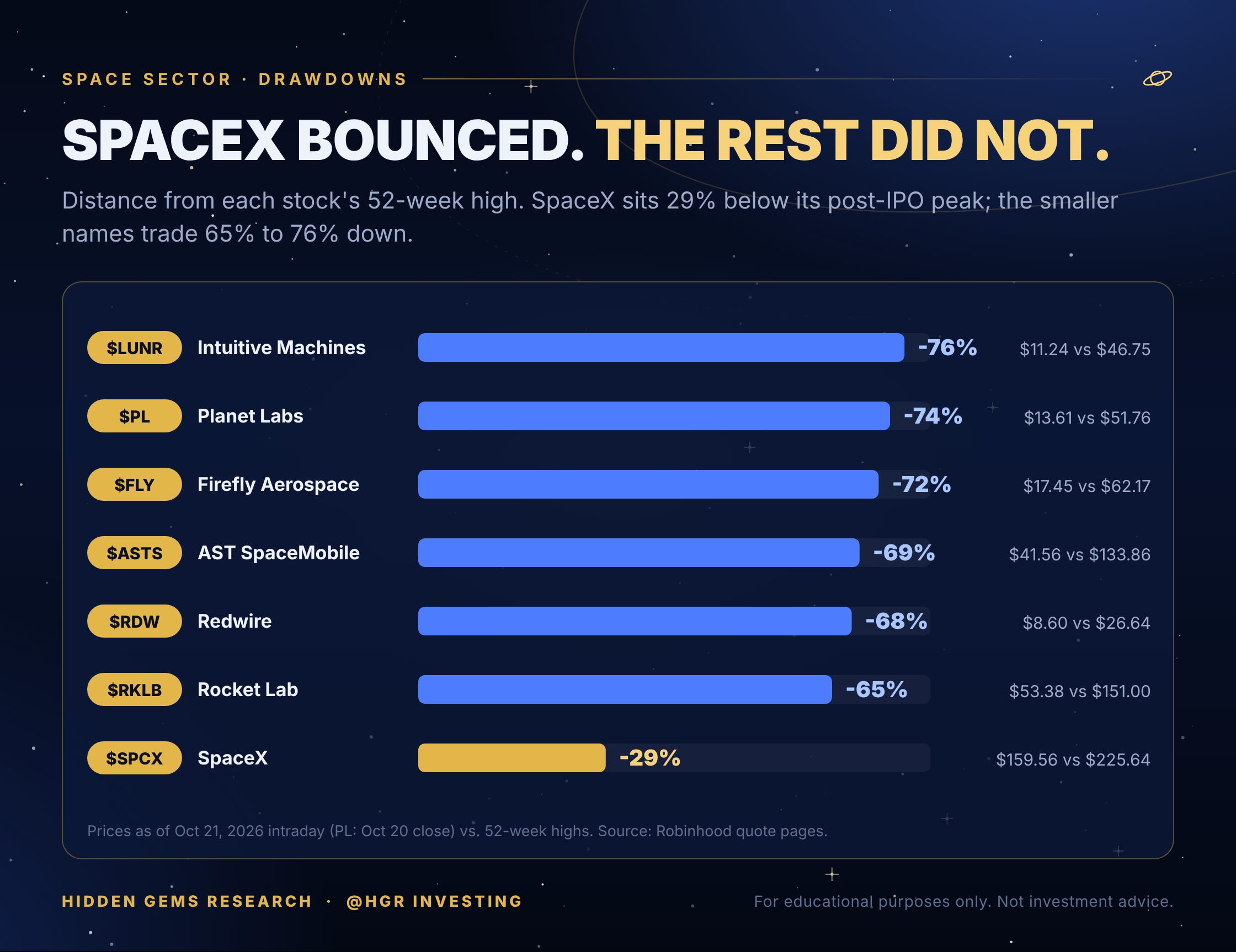
Then I pulled up the rest of the sector. Rocket Lab ($RKLB) trades at $53, down 65% from its $151 high. AST SpaceMobile ($ASTS) sits near $42, 69% below its $134 peak. I also found 4 dark horse candidates for premium subscribers that are down 68% to 76% under their 52-week highs. 2027 could be the year they finally launch.
WHAT SPACEX ($SPCX) REPORTED
SpaceX priced its IPO at $135 on June 11, opened at $150 the next morning, and closed its first day at $161. Since the listing the stock has traded as high as $225.64 and as low as $104.83. Tuesday’s numbers put it back near $160.
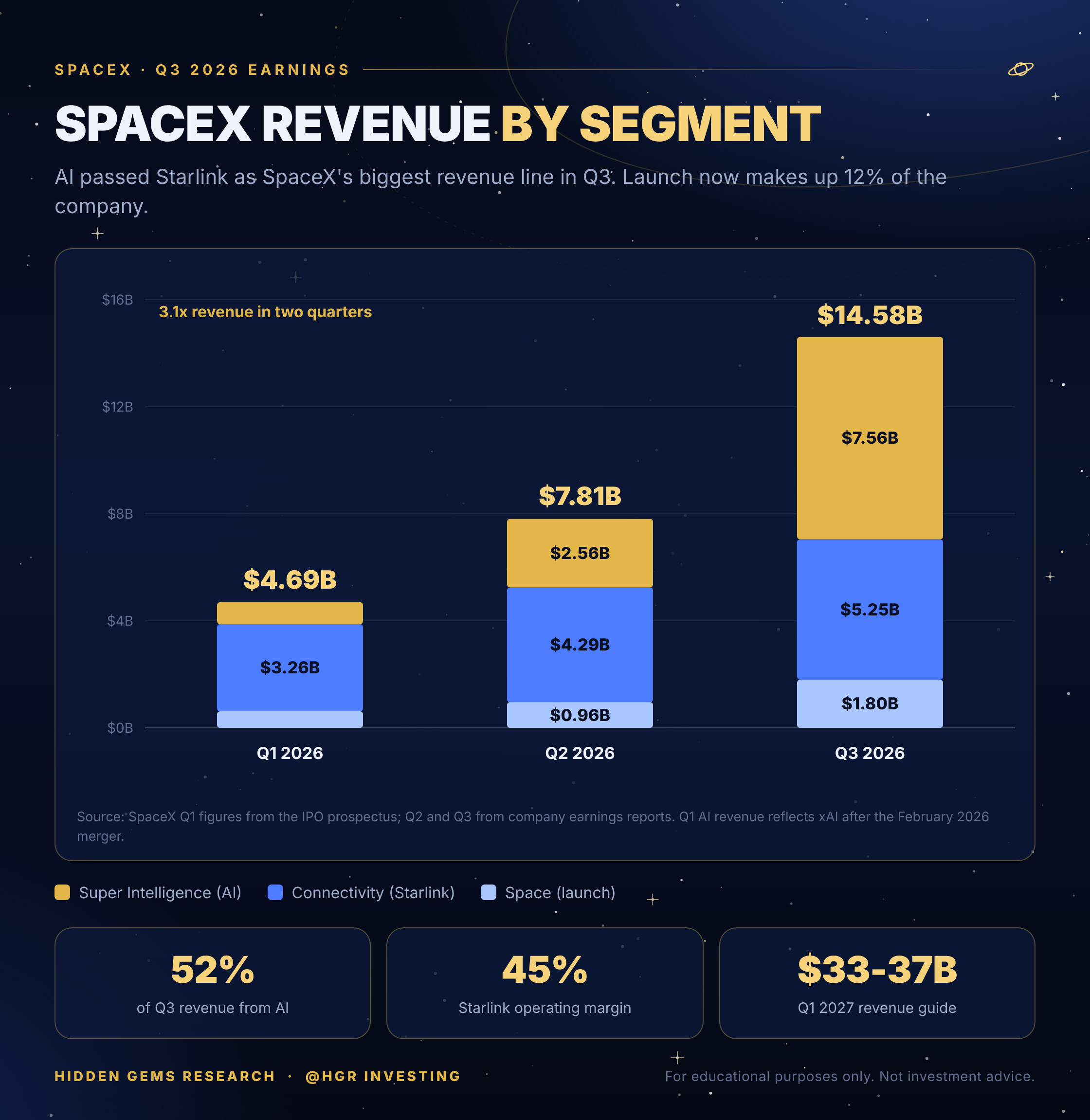
I care less about the headline beat than the segment line. SpaceX now earns more from artificial intelligence than it does from Starlink, and more from Starlink than from rockets. This is the tough part about space stocks in general. A lot of the ones actually making money aren’t doing what one might think. I’ll get into that more later in the article.
What fuels each engine
Super Intelligence: $7.56 billion, 52% of revenue. SpaceX folded in Elon Musk’s xAI in February at a $125 billion valuation for the AI company. This quarter the segment booked $7 billion in “solutions and infrastructure” revenue, including $608 million from Cursor, the AI coding platform SpaceX bought. Strip out Cursor and that line still grew 192% from Q2. Grok paid weekly users passed 800,000 in early October, and SpaceX rents spare compute to outside customers, with a target split of about half internal use and half rental. SpaceX ended September with 1.7 gigawatts of compute online and expects 2.5 to 3 gigawatts by year-end. CFO Bret Johnsen told analysts new deployments pay for themselves in under a year at current pricing.
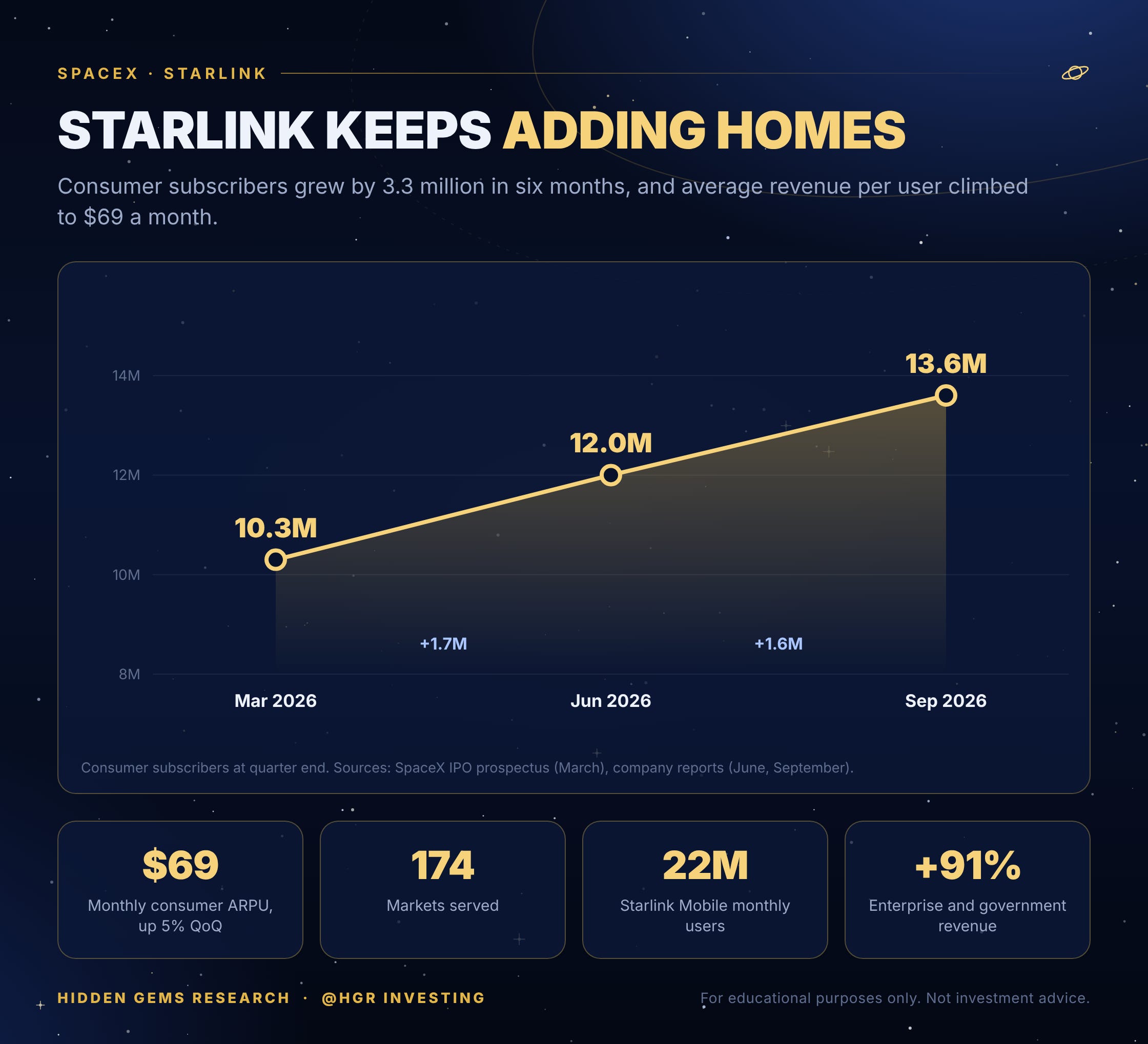
Connectivity: $5.25 billion, up 69%. Starlink added 1.6 million consumer subscribers in the quarter to reach 13.6 million across 174 markets. Average revenue per user climbed 5% to $69 a month. Enterprise and government revenue grew 91% to $2.13 billion, and Starlink Mobile, the direct-to-phone service, passed 22 million monthly users. This segment earned $2.37 billion in operating profit, a 45% operating margin. That profit covers about one-seventh of the $16.4 billion SpaceX spent on the AI build in Q3.
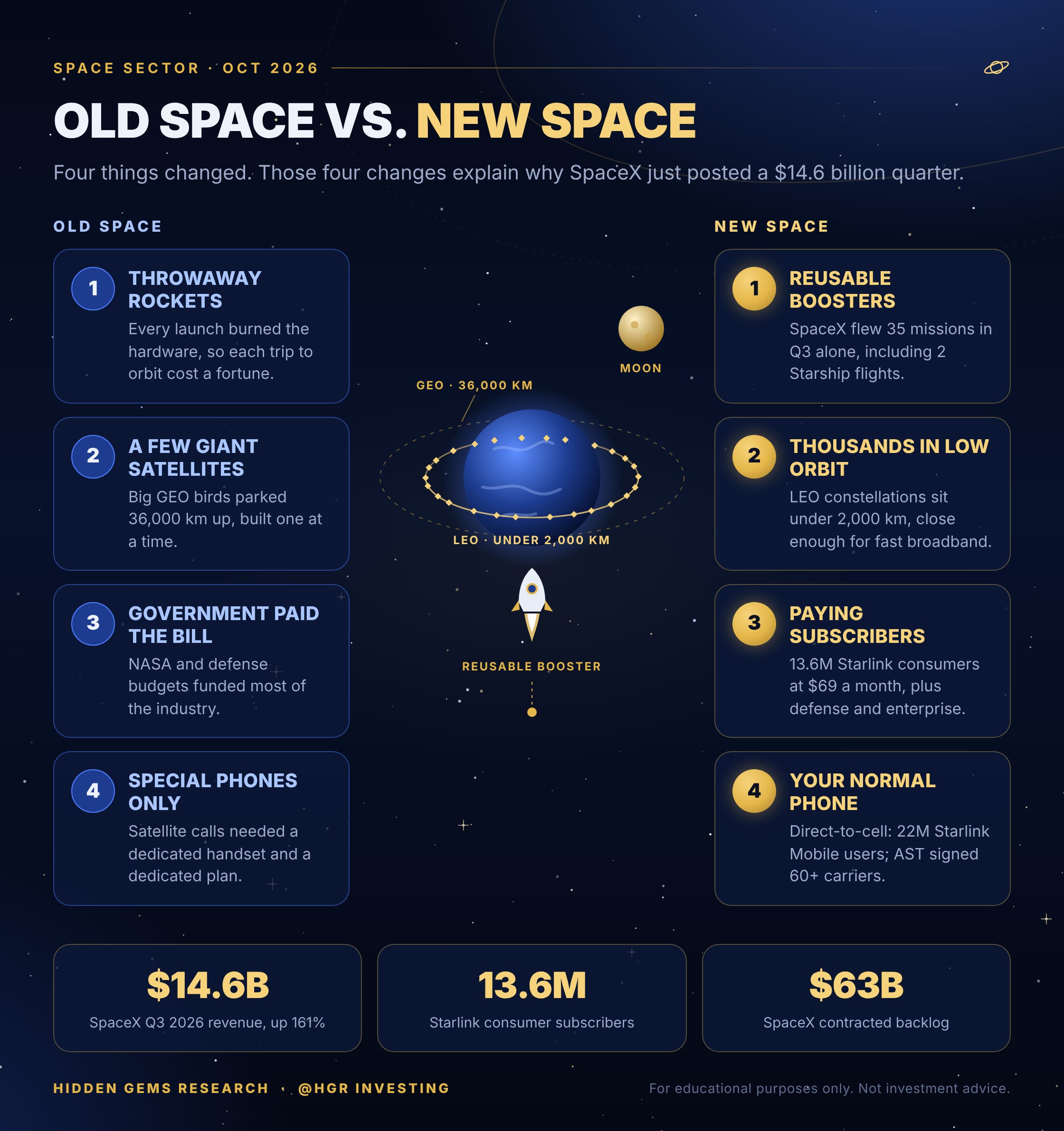
Space: $1.8 billion. SpaceX flew 35 missions in the quarter: 21 Starlink flights on Falcon 9, two Starship flights, and 12 for customers. Starship reached orbit for the first time and deployed operational V3 Starlink satellites. President Gwynne Shotwell said SpaceX signed 18 new national security launch missions. Musk expects weekly Starship launches at some point in the first half of 2027.
The guide, and the bill attached to it
Management guided Q1 2027 revenue to $33 billion to $37 billion. The midpoint runs 2.4 times what SpaceX reported for Q3. Management said annualized revenue is on track for $100 billion by the end of 2026, and Musk floated $500 billion to $1 trillion by the end of 2027. Then I read the capex line next to it. SpaceX spent $19.6 billion in Q3, $16.4 billion of it on the AI business, and guided Q4 capex to $35 billion to $40 billion. Morgan Stanley’s Adam Jonas wrote before the report that the “need for additional financing remains a key overhang for sentiment.” Johnsen said the money will come from operating cash flow, debt markets, and partnerships.
Nine firms raised targets this morning. JPMorgan went from $240 to $500. Cantor moved to $345, Barclays and Morgan Stanley sit at $300, Wells Fargo at $274, Clear Street at $248, Citi at $240, UBS at $230, and TD Cowen at $224. The lowest of those targets sits 40% above today’s price.
One more item from the call: Musk confirmed Tesla and SpaceX each formed a special committee of independent directors to study a combination. He said the committees “have not reached agreement on the terms of any transaction,” and a Tesla deal would need approval from 50% of all outstanding shares. I expect that headline to move both stocks for months.
What it means for the rest of the sector. SpaceX’s quarter proves buyers will pay for launch, broadband, and phone-to-satellite service. It also competes head-on with the two biggest names below it. Starlink Mobile goes straight at AST SpaceMobile. Falcon 9 and Starship set the price Rocket Lab’s Neutron has to beat. And SpaceX still launches satellites for Planet Labs and the Pentagon. When I own the smaller names, I own them knowing SpaceX sets the terms.
ROCKET LAB ($RKLB): BUILDING THE SECOND SPACEX
Rocket Lab runs two businesses. Launch covers the Electron small rocket and HASTE, a suborbital version the Pentagon uses for hypersonic testing. Space Systems builds satellites, solar arrays, reaction wheels, star trackers, and full spacecraft buses for the Space Development Agency, NASA, and commercial customers. Space Systems produces the majority of revenue.
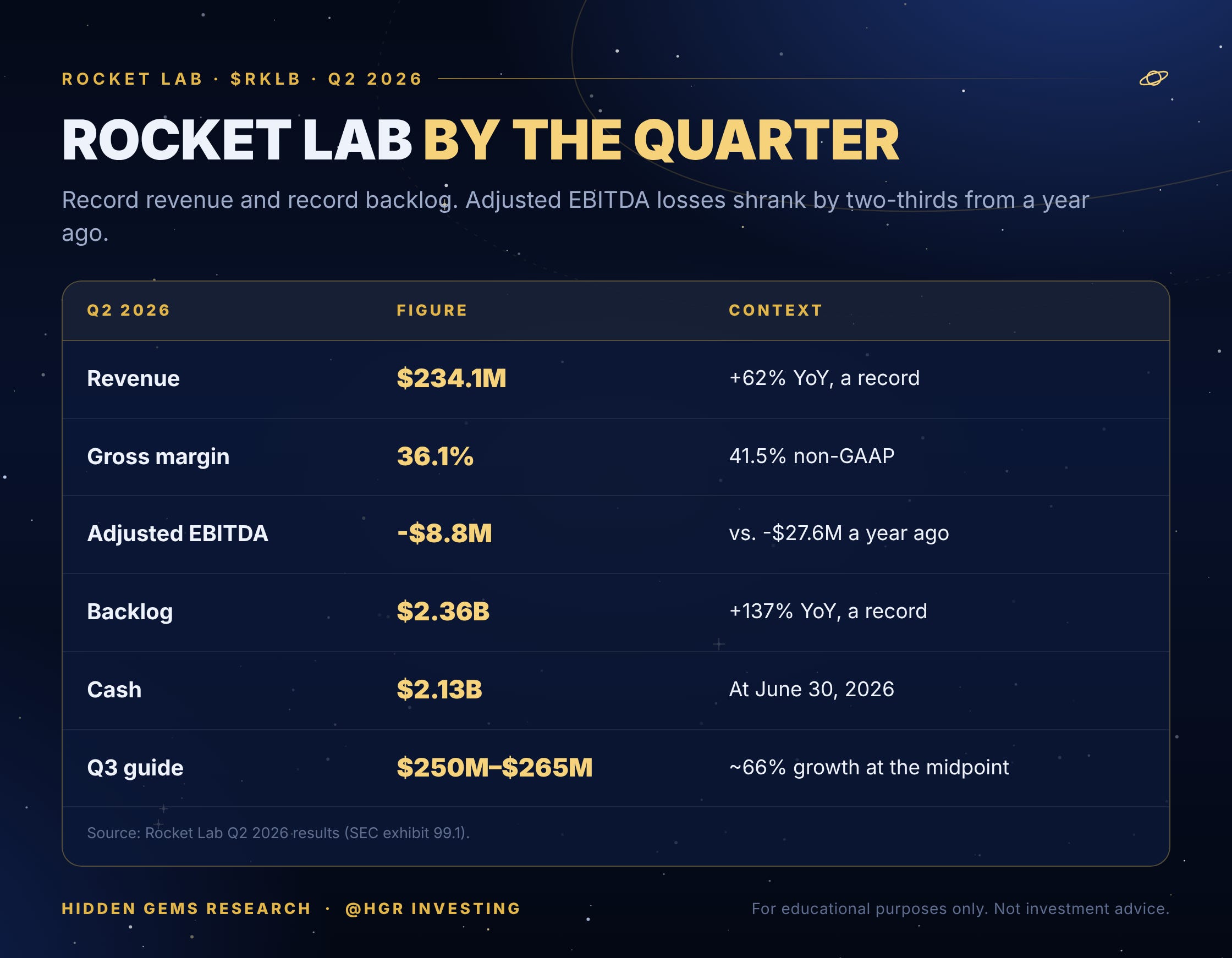
Revenue almost doubled in five quarters, from $122.6 million in Q1 2025 to $234.1 million in Q2 2026. The Q3 guide midpoint points to about 66% growth. Management says it signed more than $1 billion in new contracts during Q3, options included, and the launch backlog holds 90+ missions.
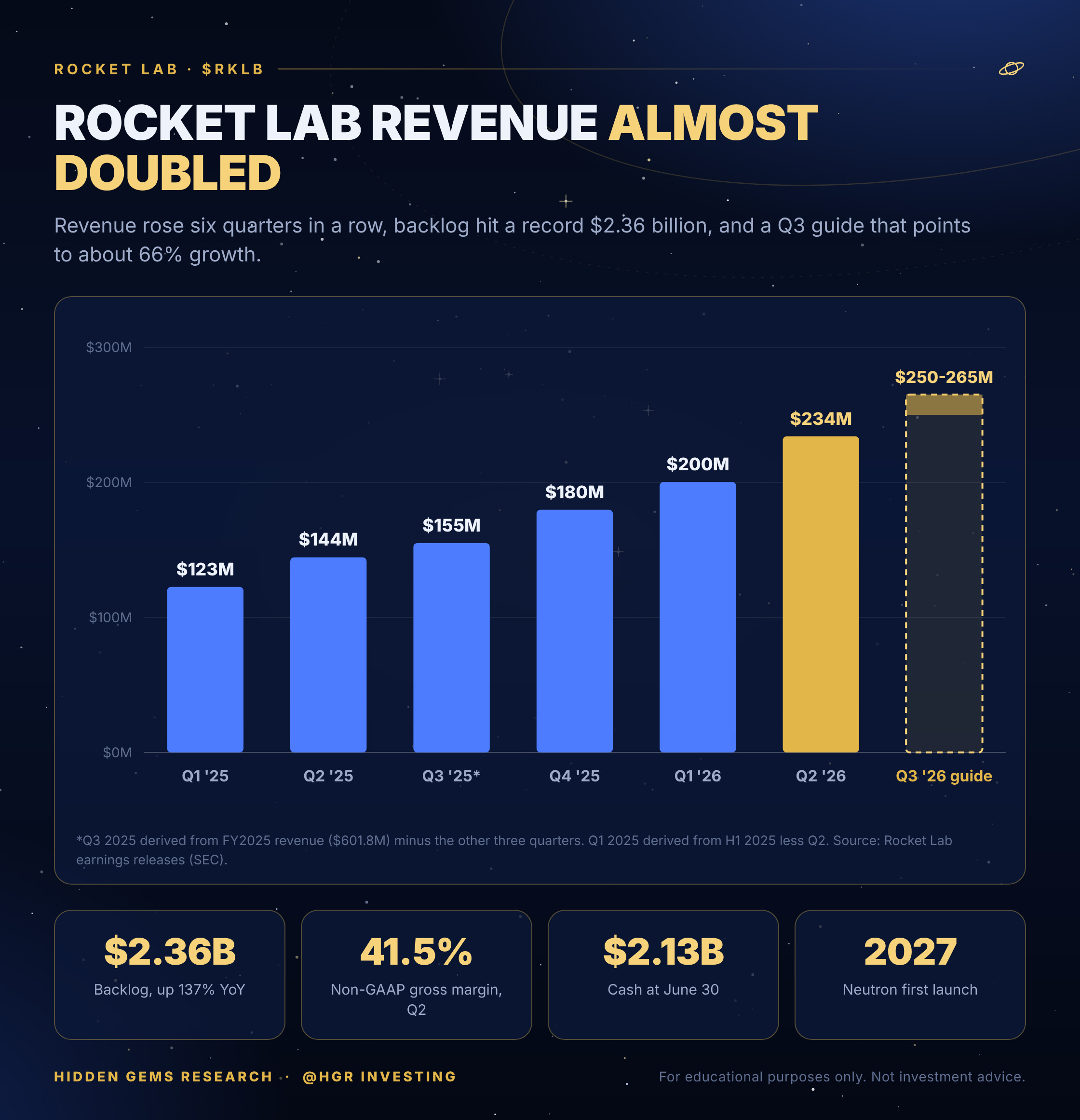
Defense customers signed the biggest contracts. In Q2 Rocket Lab won a $397 million U.S. Space Force contract for multiple Flatellite spacecraft that will fly on Neutron, plus more than $160 million across two contracts for three geostationary satellites. It closed the Mynaric (laser communications) and Motiv (robotics) acquisitions.
Then came the big swing. On June 29, Rocket Lab agreed to buy Iridium Communications for about $8 billion: $54 a share, half cash and half Rocket Lab stock, backed by a $3.6 billion bridge loan. Iridium brings 66 active satellites, more than 2.5 million subscribers, worldwide L-band spectrum rights, and $871.7 million in 2025 revenue with $495.3 million in operational EBITDA. Peter Beck called it “essentially a brand new constellation.” Add Iridium’s 2025 revenue to Rocket Lab’s trailing four quarters (about $769 million) and you get a combined company near $1.64 billion in sales, with a profitable subscription business attached. The deal still needs an Iridium shareholder vote and regulatory approval, and the companies expect it to close in mid-2027.
Now the reason the stock sits at $53. On October 14 Rocket Lab pushed Neutron’s first launch into 2027. Neutron is the reusable medium-lift rocket that lets Rocket Lab launch its own constellations and compete for the bigger contracts Falcon 9 dominates. The stock fell about 6% that day. It also carries dilution: Rocket Lab raised about $1.53 billion through at-the-market stock sales in the first half, and the Iridium stock component adds more shares. At a $32 billion market cap you pay about 41 times trailing sales. Rocket Lab reports Q3 in early November.
AST SPACEMOBILE ($ASTS): THE BET ON YOUR PHONE
AST SpaceMobile says its BlueBird satellites carry the largest commercial communications arrays in low Earth orbit. The BlueBirds talk straight to an ordinary smartphone, no special hardware, through partner carriers. AT&T, Verizon, Vodafone, Rakuten, and more than 60 other carriers covering about 3 billion subscribers have signed on. AST splits the revenue with the carrier.
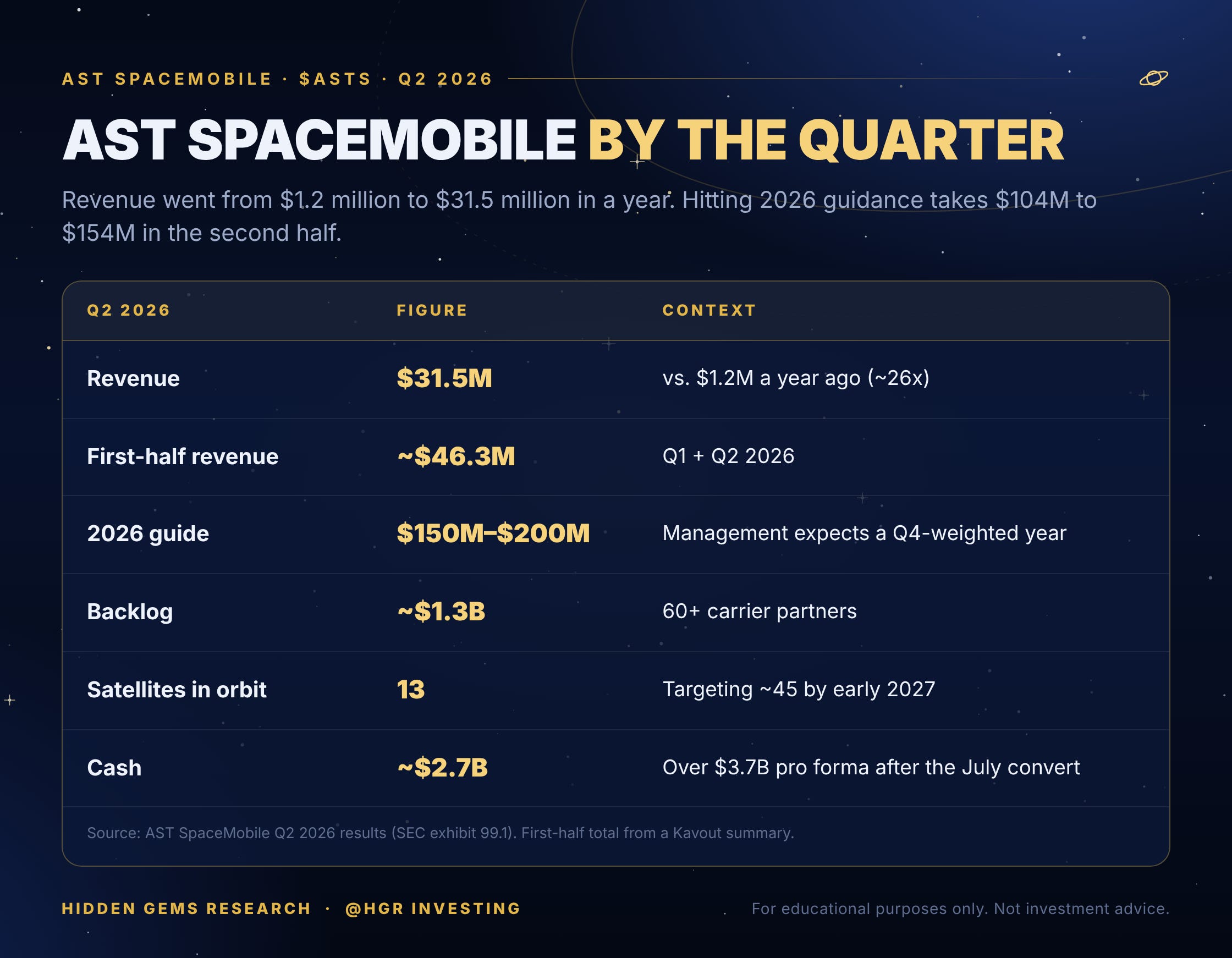
Gateway equipment deliveries and U.S. government milestones drove the Q2 jump. AST holds more than $125 million in government awards and a preliminary selection in Japan’s J-LEO program that could bring up to about $1 billion in non-dilutive capital through its Rakuten venture.
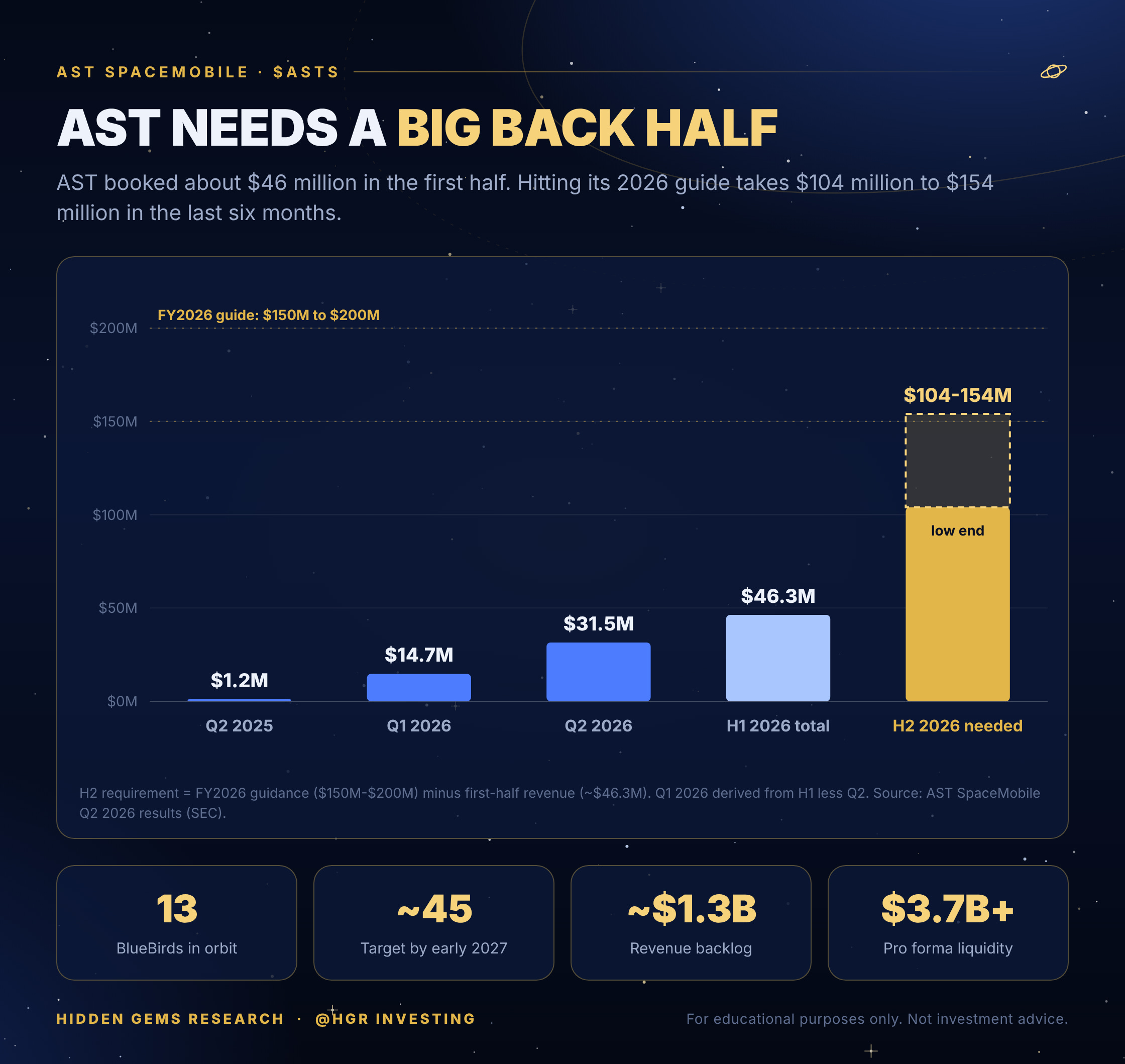
The math gets hard in the back half. AST booked about $46 million in the first half, so hitting the guide takes $104 million to $154 million in the final six months. Management told analysts to expect a Q4-weighted year. AST launched BlueBirds 8 through 13 within a 50-day stretch, has 14 through 16 ready to ship, and holds 17 through 46 in production. The company targets about 45 satellites in orbit by early 2027 and a beta service with carrier partners later this year. It lost BlueBird 7 in April after a launch anomaly on Blue Origin’s New Glenn and booked a $125.9 million loss on it in Q2.
The stock broke on October 8. SpaceX announced a deal to buy up to 14 MHz of paired 800 MHz low-band spectrum, the kind that reaches inside buildings, for Starlink Mobile. AST fell more than 10% that day, and so did Verizon and AT&T. Piper Sandler downgraded the stock to Neutral on October 13 and cut its target about 45%. A securities class action followed, centered on three separate $1 billion convertible note offerings. AST has missed EPS estimates six quarters in a row, and MarketBeat pegs full-year cash burn at $1.5 billion to $1.8 billion.
At $41.56 and a $16.2 billion market cap you pay about 92 times the midpoint of 2026 guidance. Analysts still average an $80.18 target with a Hold rating. The one detail in AST’s favor came from SpaceX itself: Shotwell said the next-generation Starlink Mobile constellation turns on service in early 2028. That gives AST about a year to put 45+ satellites in orbit and sign up paying users before the bigger competitor arrives with better spectrum.
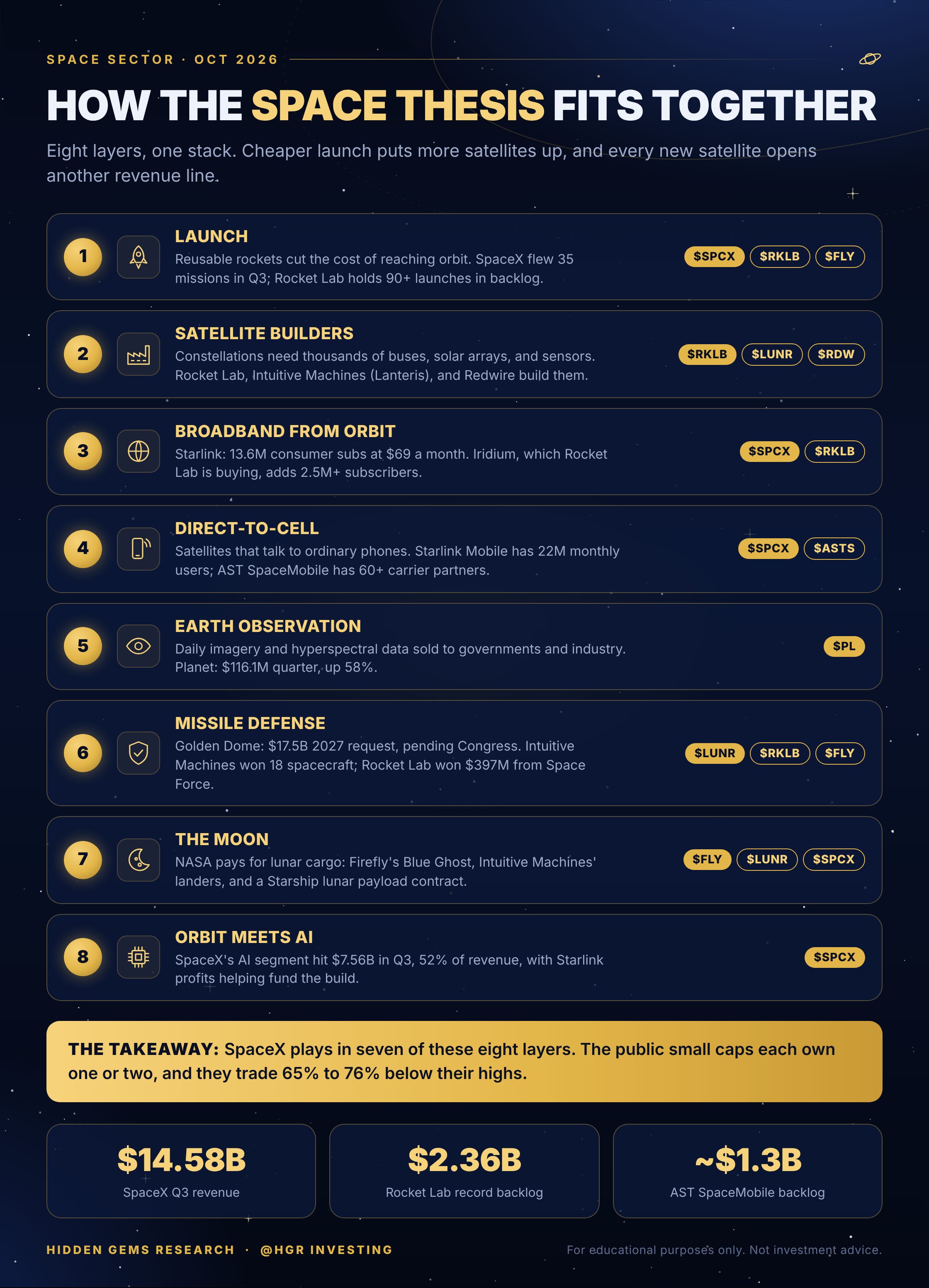
THE USE CASES PAYING THE BILLS
Broadband from orbit. Starlink’s 13.6 million consumer subscribers pay about $69 a month, and its enterprise and government line grew 91% in Q3. Airlines, cruise ships, oil rigs, and militaries buy it. Iridium adds 2.5 million subscribers in aviation, maritime, and government. Amazon’s Leo constellation is ramping toward commercial service as the next competitor.
Direct-to-cell. Your phone connects to a satellite when you lose a tower. Starlink Mobile has 22 million monthly users. AST has 60+ carrier partners and 13 satellites up. Iridium’s L-band spectrum gives Rocket Lab a third seat at this table once the deal closes.
Missile defense and national security. The Golden Dome program carries a $17.5 billion 2027 budget request, though almost all of it depends on a spending bill Congress has not passed. Intuitive Machines won 18 spacecraft for the Accelerated Missile Defense Tranche 3 layer, Sierra Space won a $798 million award for 18 missile-tracking satellites, and Rocket Lab’s $397 million Space Force contract fits the same demand.
Earth observation. Planet Labs photographs the entire landmass of Earth every day and sells the data to governments, militaries, insurers, and farmers. Its Tanager satellites see in hyperspectral, which picks up methane leaks and crop stress a normal camera misses.
Launch. SpaceX flew 35 missions in a single quarter. Rocket Lab holds a 90+ launch backlog. Firefly targets three Alpha launches this year.
The Moon. NASA pays Firefly and Intuitive Machines to land cargo on the lunar surface. SpaceX holds a contract to deliver payload to the Moon with Starship and a Starlink communications contract for Artemis III.
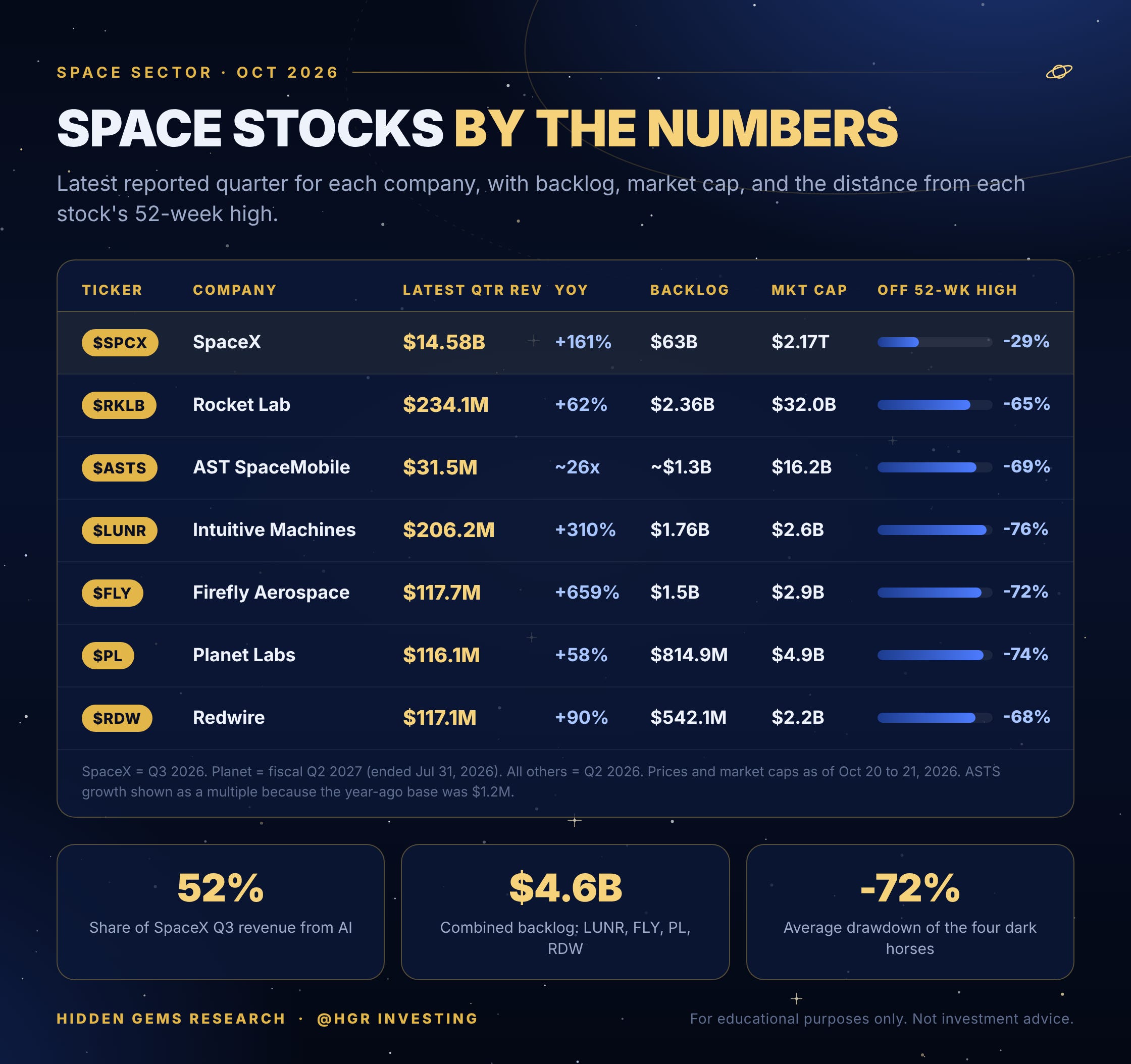
THE SCOREBOARD
My eye goes to the bottom four rows next to Rocket Lab. Intuitive Machines guides 2026 revenue to $900 million to $1 billion, close to Rocket Lab’s current annual run rate of about $940 million. You can buy it for one-twelfth of Rocket Lab’s market cap. That spread sets up the dark horse section.
Premium subscribers get the four dark horse names, my five theories for space in 2031, my levels on every ticker, and the full risk list.
We caught $ONDS at $0.67 before it ran +2600%, $LPTH at $4 before it ran +440%, and $UMAC at $7 before it ran +340%. Subscribe so you don’t miss the next one.
