


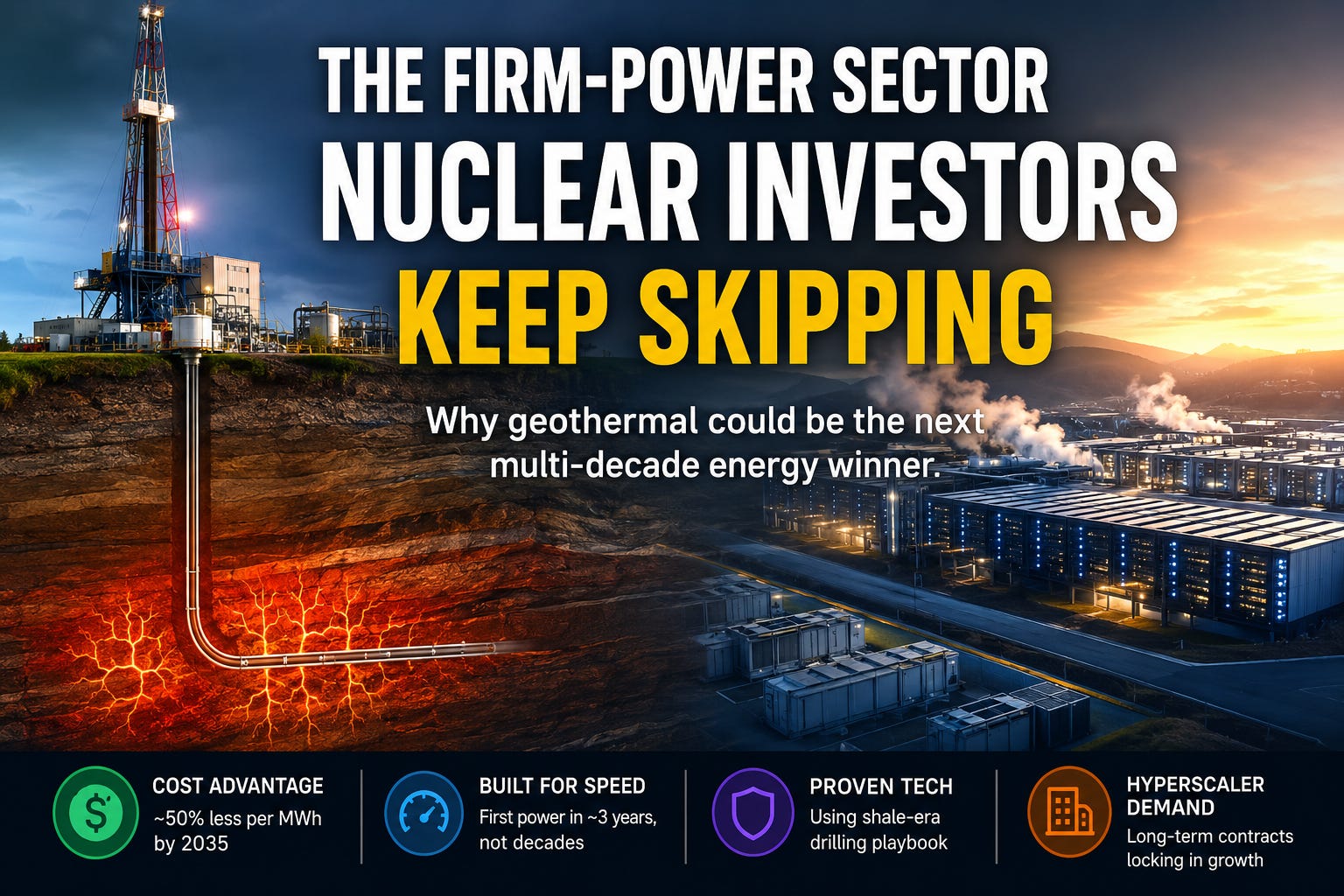
Geothermal gets a fraction of the coverage nuclear does, even though both sell the same product to the same buyers: firm, carbon-free power that runs when solar and wind cannot. Nuclear has Microsoft restarting Three Mile Island and Amazon’s deal with Talen that I’ve already covered in my Nuclear Article (check it out if you haven’t). Geothermal has smaller contracts with the same class of buyer, moving just as fast, priced at roughly half the cost per megawatt-hour.
This piece covers what geothermal actually is, who is building it, private and public, and how the sector’s economics and risks compare to the reactor build-out everyone already knows about. I also cover two public tickers behind this trade, their contracts, their numbers, and what to watch next.
What Enhanced Geothermal Actually Is
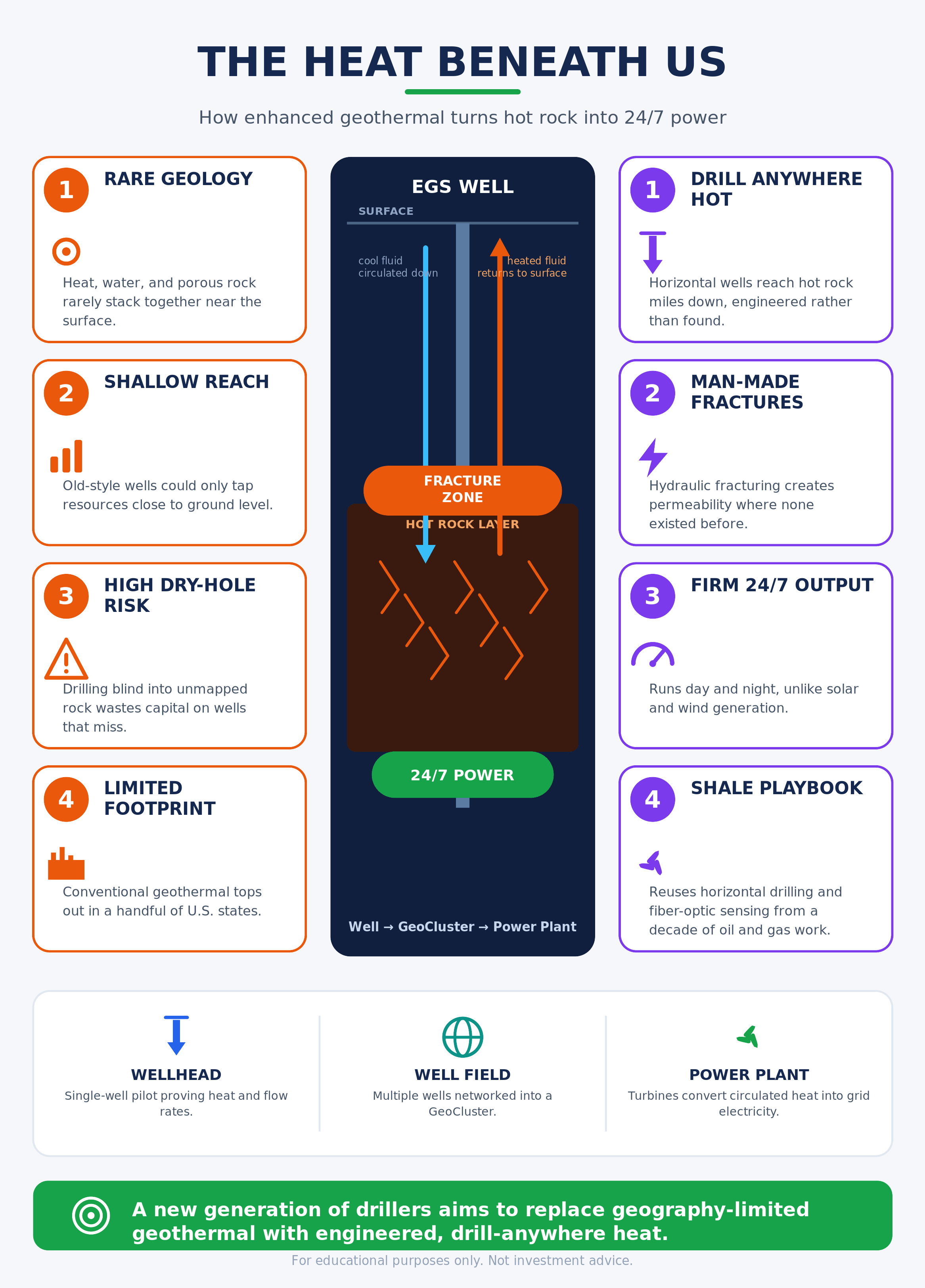
Conventional geothermal has worked for a century, but only in places where heat, water, and permeable rock happen to sit together near the surface. Iceland runs most of its grid on it. Parts of Nevada and California, home to The Geysers geothermal field, have tapped it since the 1960s. Outside those pockets, the resource stayed locked underground.
Enhanced geothermal systems (EGS) change the equation. Companies drill wells, often horizontally, into hot rock thousands of feet down, fracture that rock to create permeability where none existed, and circulate fluid through it to carry heat to the surface and spin a turbine. The leading EGS developers grew directly out of the shale industry, and the drilling techniques they use, horizontal wells, hydraulic fracturing, fiber-optic downhole sensing, are borrowed wholesale from a decade of U.S. oil and gas production. The pitch to a utility or a data center operator is simple: unlike solar and wind, an EGS plant produces electricity around the clock regardless of weather, putting it in the same “firm power” category nuclear occupies.
The U.S. currently has about 4 gigawatts of geothermal capacity installed, almost all of it conventional. The Department of Energy’s Enhanced Geothermal Shot initiative targets a 20-fold increase, to 90 gigawatts by 2050, enough to supply roughly 12% of U.S. electricity demand, if EGS costs fall the way the agency projects.
Who Is Building It
Most of the next-generation geothermal field is private which puts us in an interesting position as investors, especially when taking diversification into account. Sage Geosystems has raised $114 million, takes a brownfield approach that builds onto existing plant infrastructure rather than drilling greenfield sites, and holds a 150-megawatt power purchase agreement with Meta. XGS Energy has raised $57 million and signed its own 150-megawatt Meta deal in New Mexico, using a proprietary mineral additive it says increases heat extraction from a well by 30% to 50%. Eavor, a Canadian company that has raised $569 million, runs a closed-loop system that pipes fluid through a sealed underground loop rather than fracturing rock. It became the first company to deliver electricity to a commercial grid from a fully closed-loop geothermal plant in late 2025. Quaise Energy, with $91 million raised, is developing millimeter-wave drilling meant to reach ultra-deep, ultra-hot rock anywhere on earth rather than relying on favorable geology, the most exotic bet in the sector. Zanskar, which raised $115 million in a January 2026 Series C on top of an earlier $30 million round, uses AI to find and target drilling sites faster and cheaper than traditional exploration. None of these five trade publicly yet but are on my radar for IPOs.
Two public companies anchor the other side of the sector that I’ve been keeping an eye on. One is a decades-old geothermal operator that has run conventional plants profitably for years. It posted revenue of $403.9 million in its most recent quarter, up 75.8% year over year, with adjusted earnings per share nearly doubling as its energy storage segment grew 153.1%. The stock has rallied more than 30% over the past three months. In February, the company signed a 15-year power purchase agreement with a major hyperscaler for up to 150 megawatts, and in June it took an equity stake in one of the private EGS developers above while licensing that company’s drilling technology, a bet that its existing plants and grid connections can host next-generation tech rather than compete against it.
The other is a pre-revenue growth pick (which we love hear at Hidden Gems Research) that priced its IPO at $27 a share in May 2026, the largest clean-energy IPO in recent memory, and raised $1.89 billion. Shares opened near $35, hit an all-time high of $42.65 within weeks, then settled into the mid-$20s, a market cap near $7.5 billion built almost entirely on contracts and construction milestones rather than revenue. The company holds 658 megawatts of binding power purchase agreements, worth an estimated $7.2 billion over their contract lives, plus a 3-gigawatt framework agreement with the same class of hyperscaler buyer signing deals across the sector. Its flagship U.S. project is under construction now, targeting first power before the end of 2026. Until that power flows, the company remains a construction story: a $31.8 million net loss last quarter against $172.8 million in capital spending, with roughly $1.2 billion more in capex guided through early 2027.
Geothermal vs. Nuclear: The Case For Geothermal
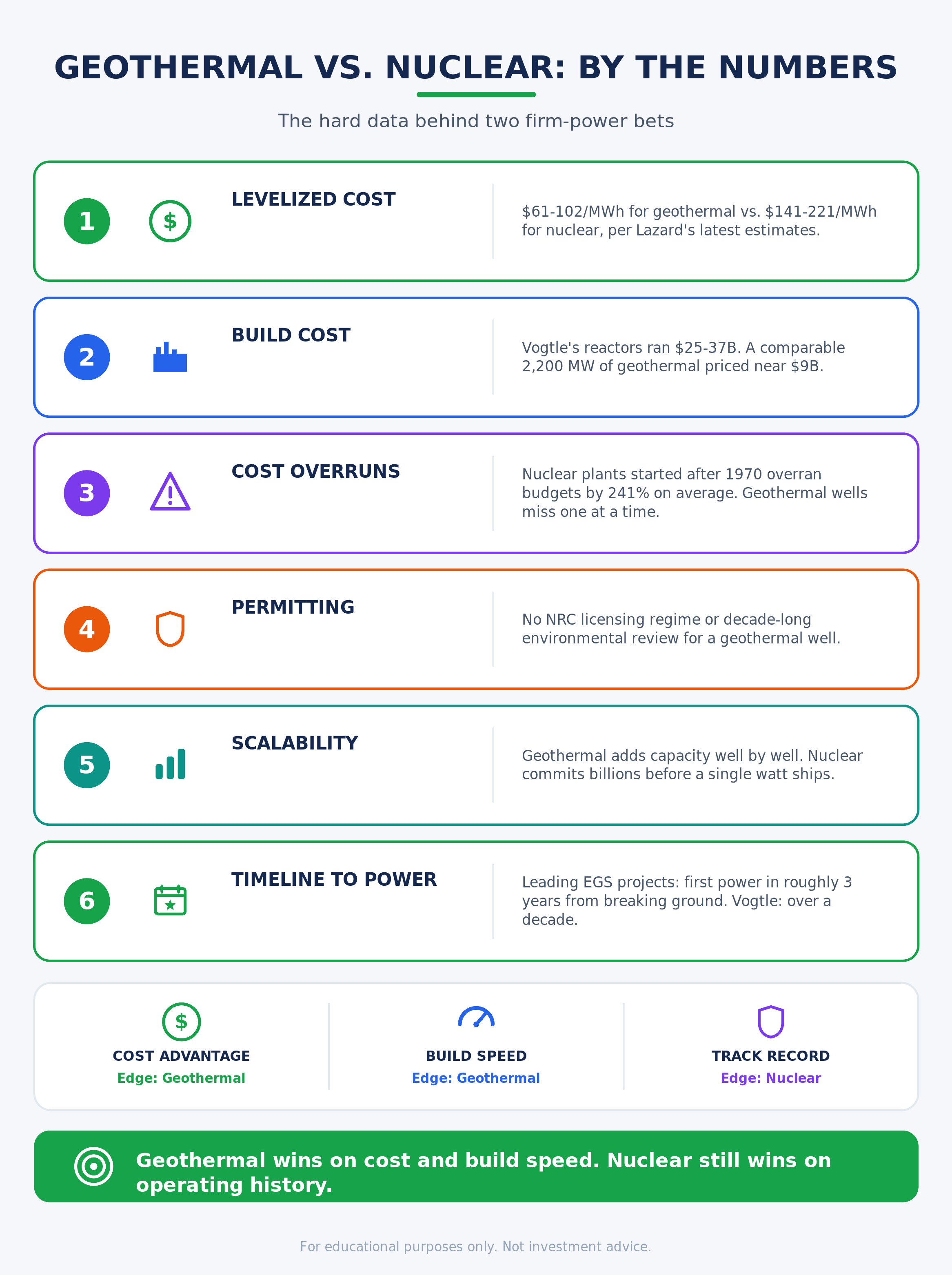
Lazard’s most recent levelized cost of energy analysis puts geothermal at $61 to $102 per megawatt-hour and nuclear at $141 to $221 per megawatt-hour, roughly double. Even without subsidies, geothermal projects run about $119 per megawatt-hour against nuclear’s approximately $140. The Department of Energy’s own liftoff analysis expects next-generation geothermal to reach $60 to $70 per megawatt-hour by 2030, on a path toward its $45 target by 2035.
The construction risk gap is just as wide. Georgia’s Vogtle nuclear expansion, the only new U.S. reactor built in decades, ballooned from an initial $14 billion estimate to somewhere between $25 billion and $37 billion and took years longer than planned. One industry analysis found that 2,200 megawatts of geothermal capacity would have cost about $9 billion, less than half of Vogtle’s price tag for a comparable amount of firm power. Nuclear construction has a documented pattern of this: plants started after 1970 overran their initial cost estimates by an average of 241%. Geothermal wells get drilled one at a time using equipment and crews the oil and gas industry has run for decades, so a delay or a bad well sets a project back by weeks instead of months or even years. Geothermal also skips nuclear’s regulatory runway. There is no NRC licensing process, no decade-long environmental review, and no spent fuel to manage. And because EGS projects scale by drilling additional wells rather than building a second reactor, a developer can add capacity in stages instead of committing billions before any power ships.
Geothermal vs. Nuclear: The Risks I See
The sector’s flagship U.S. project is the first real test of whether EGS is repeatable infrastructure or a boutique product, and nobody will know until it reaches first power before the end of this year whether it performs at the scale its contracts assume. The DOE’s $45-per-megawatt-hour 2035 target and the leading pure-play’s own $100 to $130 per megawatt-hour long-term pricing goal are targets the industry has to hit with past results being less impactful.
Geography is also still relavent even with EGS. The best hot rock in the U.S. sits concentrated in the West, Utah and Nevada especially, which is why the current flagship projects sit there rather than closer to East Coast data center demand. Quaise’s millimeter-wave approach is the one technology aiming to make location irrelevant, but it still remains as the earliest-stage bet in the sector leading analysts to be weary on the deliverables.
Capital intensity is the risk investors will feel first. Every geothermal developer, public or private, spends heavily before a well produces a dollar of revenue, and the leading pure-play’s roughly $1.2 billion capex guide through early 2027 sits on top of an already-large IPO raise. Any slip in construction timelines or in the pace of new power purchase agreements raises the odds of dilution or a funding gap somewhere in the sector.
Why Nuclear Still Gets the Bigger Headlines
Geothermal’s underdog status has less to do with the technology and more to do with the story built around it. Nuclear has 70 years of grid operating history behind it; the newest geothermal flagship plants do not produce power until later this year. Nuclear also carries a coordinated policy push, SMR-specific legislation, DOE loan programs, and a wave of high-profile startups, while geothermal’s leading voices are mostly ex-shale engineers running a quieter, well-by-well buildout that produces smaller headline numbers even as it reuses a mature drilling supply chain. Both sectors are chasing the same AI-driven demand for firm power, but nuclear’s data center deals landed in the news well before geothermal’s hyperscaler commitments caught similar attention.
Thanks for reading this far! Subscribe for free to receive new posts and support my work. Everything below this line relates to real publicly traded tickers behind this thesis, their financials, their contracts, and what I’m watching next.
