



There’s a moment in an investor demo when you stop taking notes and start staring. I was in that room in Minneapolis, a small group, ten institutional investors, sitting across from this company’s CEO. He didn’t talk like a man running a small-cap. He talked like a man who knew something the market hadn’t priced.
He was right.
Here’s what he said that stayed with me: “The copper wall is the ability for GPUs to connect through copper traces. And that technology is actively gauging AI adoption rates. It’s simply not fast enough. The bandwidth isn’t there. And it’s too power hungry.”
That sentence is more impactful than you know. It describes a real bottleneck the entire AI infrastructure build-out is running into right now, and the solution isn’t coming from Nvidia or Google or any of the names CNBC covers every morning. It’s coming from a 40-year-old company in Massachusetts that most people have never heard of. This is how we find them before they run.
WHY THIS MOMENT IS DIFFERENT
Let me give you the analog first. Think about $LPTH - LightPath Technologies. We got in when it was ignored, when the AI photonics thesis was forming and the market hadn’t connected the dots yet. The stock ran +440% from where we caught it. $KOPN rhymes with that pattern but the inflection point is larger.
The AI data center build-out has a chokepoint nobody talks about on financial TV: the connections between GPUs. Right now, those connections run on copper. Copper traces. The same technology your high school electronics teacher showed you. The problem is physics: copper taps out at roughly 800 Gbits per second, and current-generation GPUs are already generating 1.6 terabits of data. Next-gen systems are pushing toward 3.6. The pipe doesn’t fit the water. And when the pipe doesn’t fit, you throttle the whole system, which is exactly what’s happening to AI adoption rates right now.
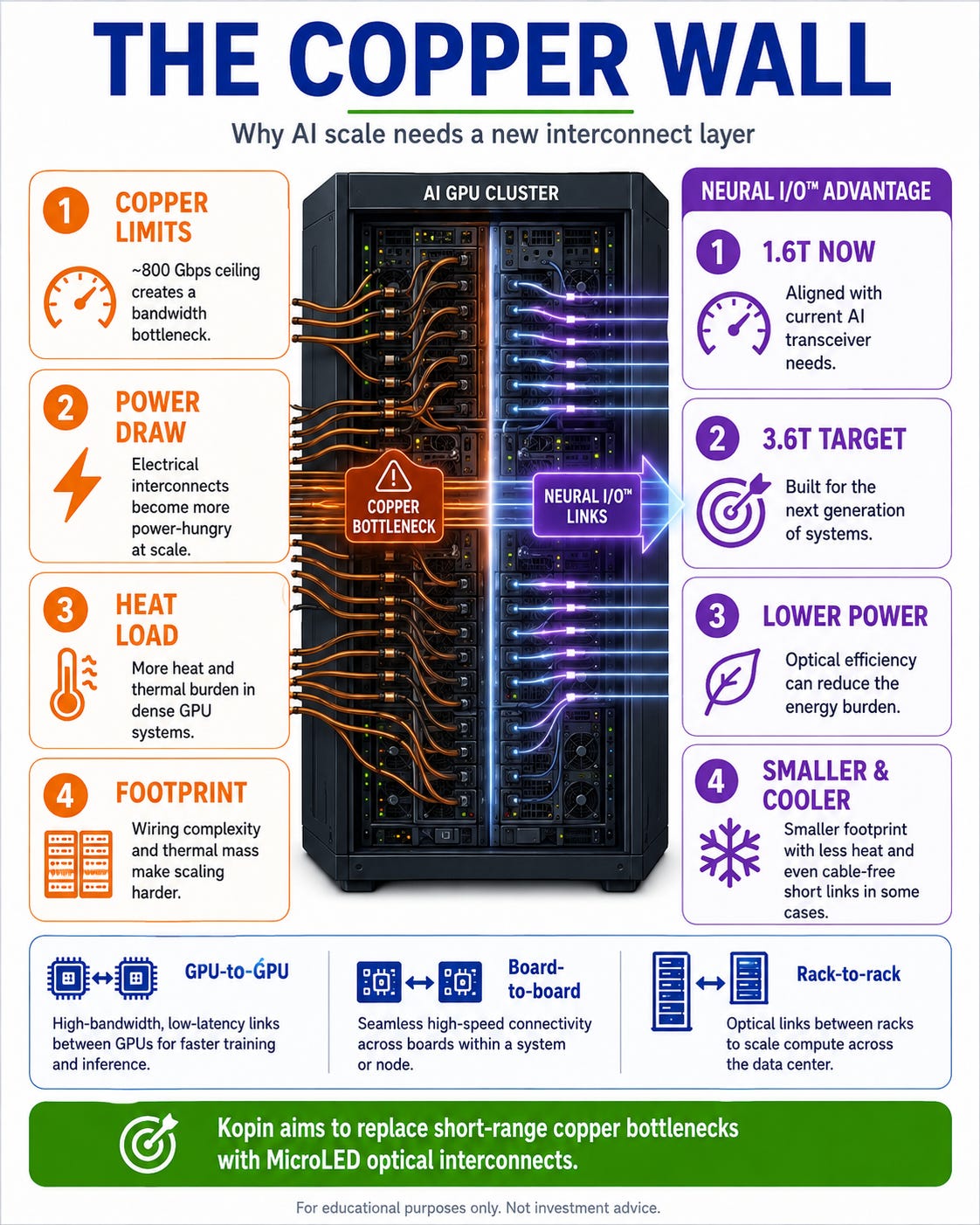
Fiber optics solve some of the bandwidth problem, but they come with a different tax: constant power to stay on, significant heat generation, larger physical footprint, and higher cost. MicroLEDs sit between those two. More bandwidth than copper. Lower power than fiber optic. Smaller footprint. More economical. That is Kopin’s Neural I/O™ — and in Q1 2026, they landed a commercial partner to bring it to market.
THE FABRIC.AI DEAL — WHAT IT ACTUALLY MEANS
In May 2026, $KOPN announced a strategic collaboration with Fabric.AI - a $15 million initial development order to jointly build Neural I/O™: a MicroLED-based optical interconnect designed to replace copper wiring between GPUs and high-performance processors in AI data centers. This is a commercial partner writing a check because they believe this technology will change how data centers are built. Here’s what makes the structure bullish. Kopin received the $15M development order and a 19.9% equity stake in Fabric.AI, as the exclusive manufacturer of Neural I/O™ chipsets. Meaning Kopin doesn’t just get paid to build the product they also own a piece of the company that’s commercializing it. The addressable market they’re entering is a $69 billion AI infrastructure communications opportunity by 2030.
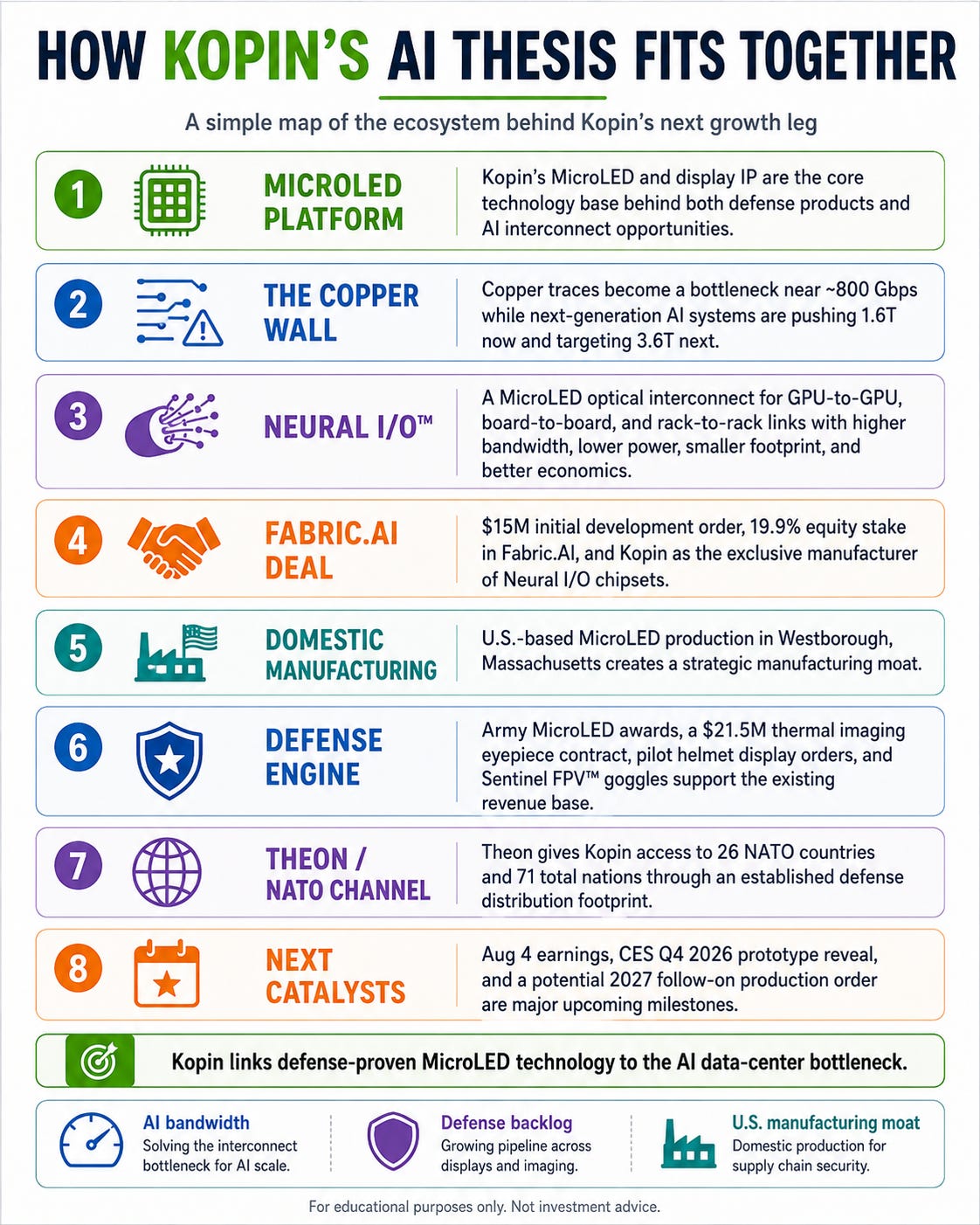
And here’s the detail almost nobody is discussing: this market requires U.S. manufacturing by law for U.S. Government and Department of War applications. Kopin already has a domestic MicroLED production line, funded by a $15.4 million IBAS award from the Secretary of War, running in Westborough, Massachusetts. Their competition? They have to figure out how to build a MicroLED first, then build a production line, then get it approved. Kopin already has all three. They’re just putting the pieces together.
THE DEFENSE BUSINESS IS NOT A SUPPORTING CHARACTER
Before we even get to data centers, let’s talk about what’s already producing revenue because the defense business alone would make this company worth watching. Over the last twelve months, the contract wins have been stacking. In September 2025, $KOPN received a $15.4 million IBAS award from the U.S. Army for color MicroLED development for soldier-borne mission systems, a program representing a $1 billion serviceable available market in the United States alone, with a similar product already negotiated with their Theon partnership for the European market. That was followed in April 2026 by a Phase I SBIR contract from the U.S. Government for a second, smaller-format full-color MicroLED display for soldier-borne applications marking the second Army MicroLED award in six months. Q1 2026 brought a $21.5 million follow-on thermal imaging eyepiece production contract from a major U.S. defense prime, along with $5.6 million in new European pilot helmet-mounted display orders that pushed their pilot helmet order book above $10 million.
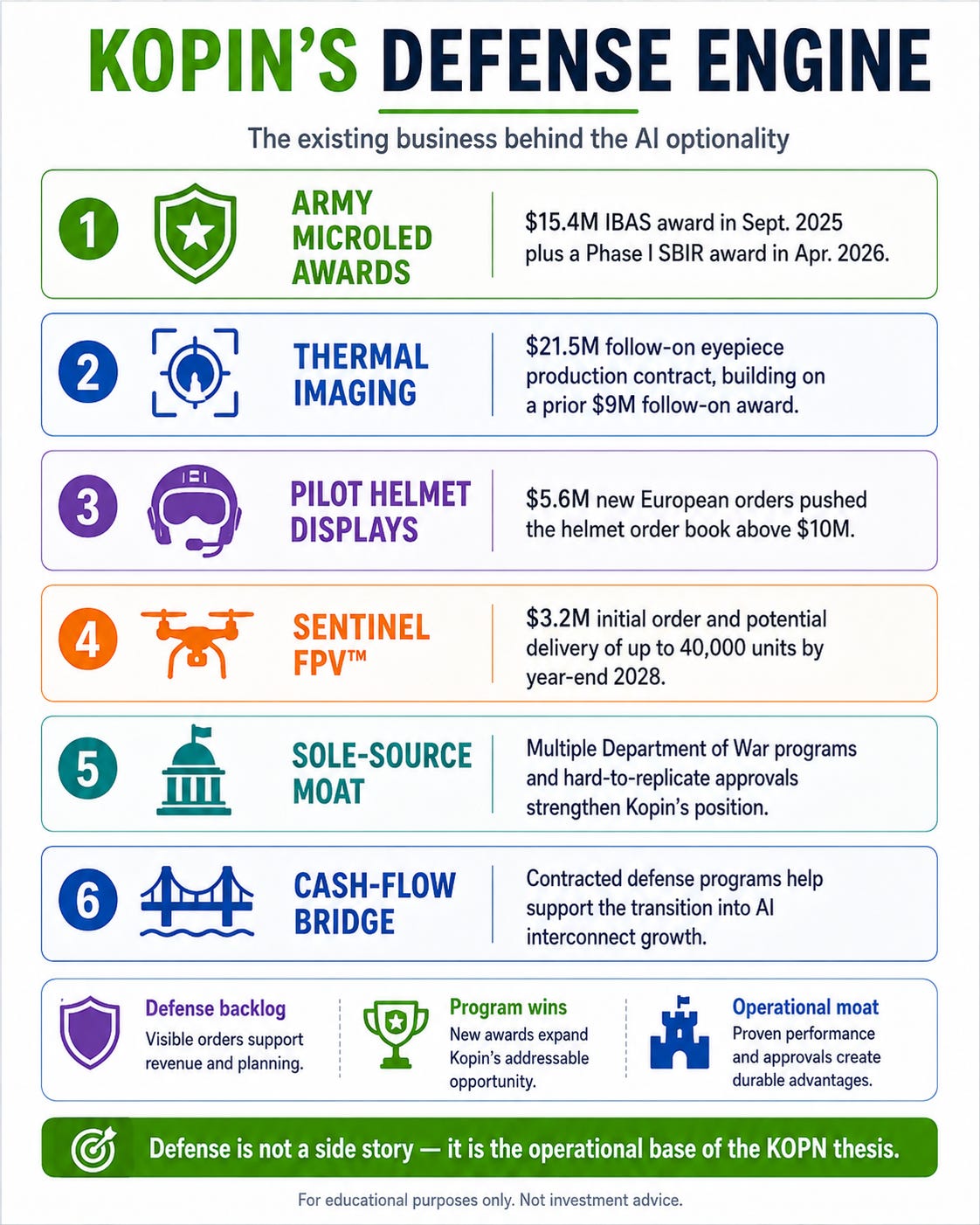
They also entered the FPV drone market with their Sentinel FPV™ goggle on a $3.2 million initial order, with potential delivery of up to 40,000 units by year-end 2028, a market that didn’t exist for them eighteen months ago. And sitting behind all of this is a prior $9 million follow-on thermal imaging contract from August 2025 that never got the attention it deserved. This is a company with a growing, funded, contracted backlog and the CEO holds sole-source status on multiple Department of War programs. That is a real moat. Auditable. Hard to replicate.
THE THEON PARTNERSHIP — NATO UNLOCKED
Here’s the leg of the stool most retail investors are sleeping on. Kopin’s partnership with Theon International gives them immediate commercial access to 26 NATO countries and 71 total nations, with over 200,000 Theon systems already deployed with armed and special forces worldwide. Theon is listed on Euronext Amsterdam and has an aggressive three-year revenue and technology-sharing plan underway with Kopin across Europe and Southeast Asia. The same MicroLED technology winning Army contracts in the United States - Kopin has already negotiated a similar product with Theon for the European market that is documented in their filings.
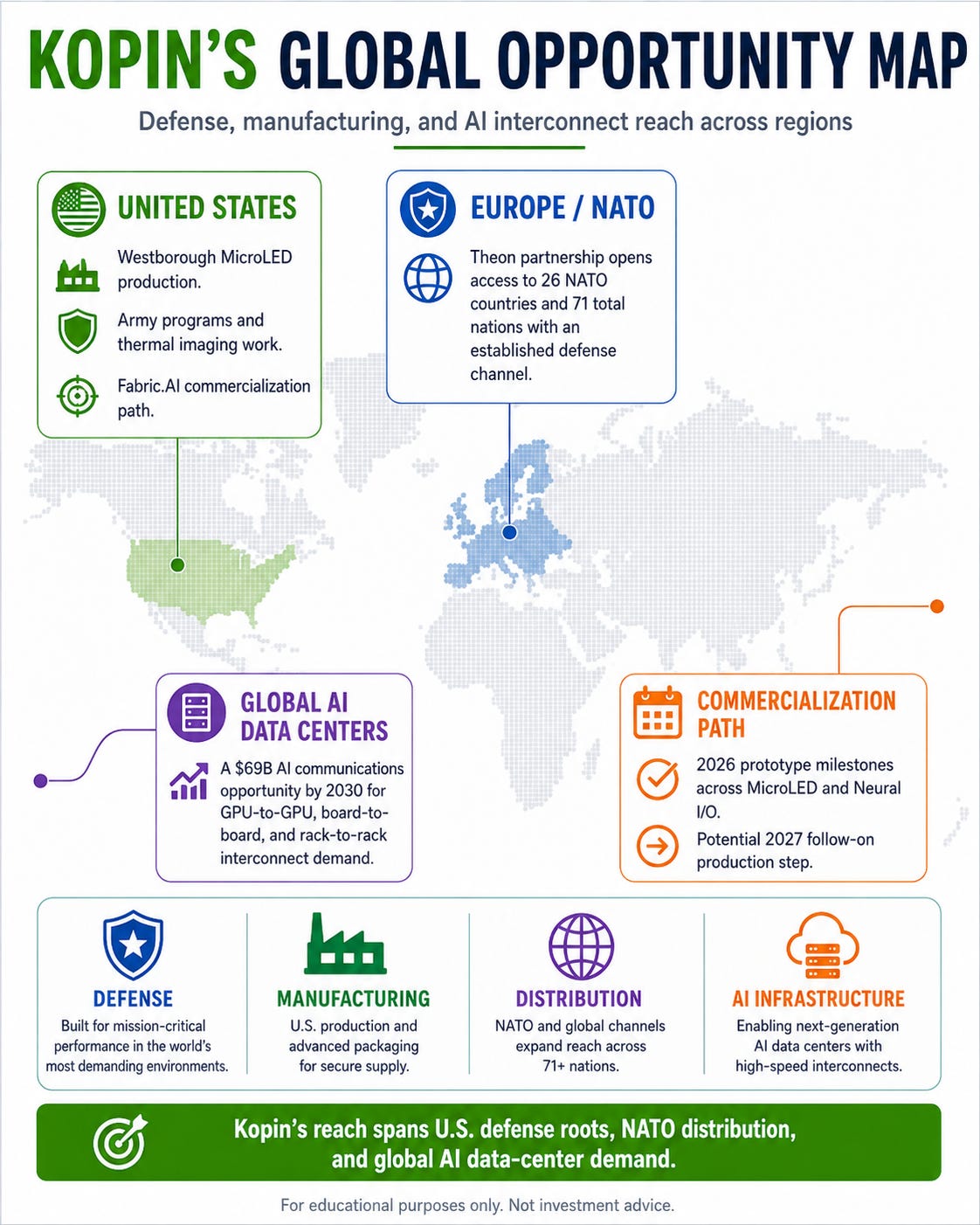
NATO defense budgets are rising across the board. Every ally is modernizing. Night vision, thermal imaging, AR data overlays for soldiers in the field, Kopin supplies the optics that make those systems work. Defense plus NATO plus AI infrastructure. Three runways. One small cap company.
THE NUMBERS
The Q1 2026 financials tell the story of a company in transition, investing heavily while contracted revenue builds behind it. Total revenues came in at $10.6 million, essentially flat year-over-year, but the composition shift is what matters. Non-product revenues funded R&D, collaborative agreements, grant revenue hit $5.2 million, up 292% year-over-year. That is the Fabric.AI development money flowing in. Cash stands at $34.1 million in equivalents, with $59.5 million in total liquidity including restricted cash and marketable securities. Management confirmed the company is funded through at least Q2 2027. Full-year 2026 guidance sits at $52–$60 million in revenue.
On the stock, the price action since early April tells the setup. The 52-week low hit on April 9, 2025 at $0.718, that was the floor. The stock entered 2026 near $2.49, grinded higher through Q1, then broke out hard on the Fabric.AI announcement and Q1 earnings in May. It ran from under $3 in mid-April to an intraday high of $6.45 on earnings day over 100% in under six weeks. It has since pulled back to the $4.75–$5.00 range as the momentum trade faded. That pullback is the entry window for the thesis investor.
The analyst community is aligned in a way that’s rare for a name this size. Six firms cover $KOPN, and the consensus is Strong Buy. Stifel sits at $6.50, Canaccord at $6.25, Lake Street at $7.00, Jones Trading at $6.00, and Craig-Hallum, the most aggressive, raised their target to $10.00 on earnings day. The average 12-month price target is $7.63. That’s roughly 55% upside from where the stock is trading today. Craig-Hallum’s $10 would be a double.
THE NEURAL I/O TECHNOLOGY - WHY IT ACTUALLY WORKS
I sat across from Murray as he walked through the architecture, and here’s the plain English version. MicroLEDs operate like a laser for short-to-medium distances - GPU to GPU, board to board, rack to rack - up to about 15 to 25 feet. Within that range, Kopin’s Neural I/O™ can already achieve 1.6 terabits per second, with a target of 3.6 terabits next year. That’s the number that unlocks the next generation of AI GPU transceivers. In terms of the physical connection itself, in some cases, there isn’t one. Murray described over-the-air light transmission for board-to-board communication. No cable. No copper traces. No fiber optic runs. You remove the thermal mass from the data center floor entirely, which is a meaningful variable in a world where new data center builds are being held up by power constraints and cooling costs.
The brownfield opportunity is the layer most people aren’t modeling. Legacy data centers don’t get thrown out when new chips arrive, they need interface boards, and Kopin has software integrated into Neural I/O™ that specifically targets the bridge between existing and new architectures. That’s an additional revenue layer built into the same product. The demo timeline is clearly staged. The key technology components, the MicroLED and the Neural Display bidirectional transceiver, are already in production and demonstrable. The $15 million from Fabric.AI is funding the productized prototype, which Kopin is targeting to unveil at CES in Q4 2026. The expected follow-on order in 2027, at similar or greater scale, would fund the transition to full production through their domestic fabrication plant.
My Conviction
I’ve been doing this long enough to know the difference between a CEO who’s reading slides and a CEO who believes. Michael Murray believes.
He walked us through the technology without notes. He answered every skeptic’s question directly. He wasn’t selling a dream, rather he was showing evidence. The MicroLED is already in production and already flying in aircraft. Neural Display is already demonstrable, people in that room wore it and made it work (me included!). He has NDAs signed with some of the largest companies in the world on GPU-to-GPU transmission work that he can’t name publicly yet - remember that. That’s what institutional demos feel like when the company has something real.
HOW I’M PLAYING IT
I’m approaching $KOPN with a three-layer structure built for both income and upside.
On the share side, I’m building a position in the $4.50–$5.50 range as the post-earnings pullback settles. The thesis doesn’t require a perfect entry to work at these levels — the catalysts ahead include Q2 earnings on August 4, the CES prototype reveal in Q4, and ongoing Fabric.AI development milestones that will each generate their own re-rating moment.
On the options side, I’m selling cash-secured puts at the $4 , $4.50, and $5.50 strike to generate premium while waiting for the right share entry. Given KOPN’s beta of 3.77 and the elevated implied volatility that comes with it, premium is rich, you collect income and either pocket it or acquire shares at a discount depending on where the stock goes. Once the share position is established, covered calls at the $6.50–$7.50 range give a third income stream on top of share appreciation.
For the longer-duration thesis, I’m watching 2027 LEAPS in the $5–$10 strike range. The Neural I/O story is a 2027 catalyst event, the follow-on production order, CES commercial momentum, and the Fabric.AI partnership maturing all fall in that window. LEAPS give the thesis room to breathe without the decay pressure of shorter-dated contracts.
THE RISKS
I always tell you what could go wrong. Here it is straight.
Dilution is real. Kopin completed a $56 million private placement in late 2025, and more capital raises are possible as they invest in OLED manufacturing and Neural I/O development. Watch the share count on every filing. Timeline risk is equally real, the CES demo is a goal, and technology development slips. If the Neural I/O prototype is delayed, the re-rating gets pushed out with it.
The company is not profitable. EBITDA is running at approximately negative $16 million. R&D expenses jumped 133% year-over-year in Q1 as they invest aggressively in the next phase of growth. This is a high-conviction growth bet, not a value play, and it needs to be sized accordingly. Additionally, $25.3 million of their cash is restricted against the ongoing BlueRadios litigation appeal, real money that isn’t available for operations while the case is unresolved. Government budget exposure remains a watch item. A meaningful portion of Kopin’s revenue flows through U.S. Department of War contracts and congressional appropriations. Continuing resolutions and budget delays already impacted them in 2025, that risk doesn’t disappear. And while Kopin has a significant head start in MicroLED optical interconnects, well-capitalized players will enter when the market proves out. Execution over the next 18 months is everything.
THE BOTTOM LINE
Forty years old. Three years into a full transformation. U.S. defense growing. NATO unlocked through Theon. And now a $15 million paid commercial partnership with an equity stake to crack the AI data center market with technology they already have in production.
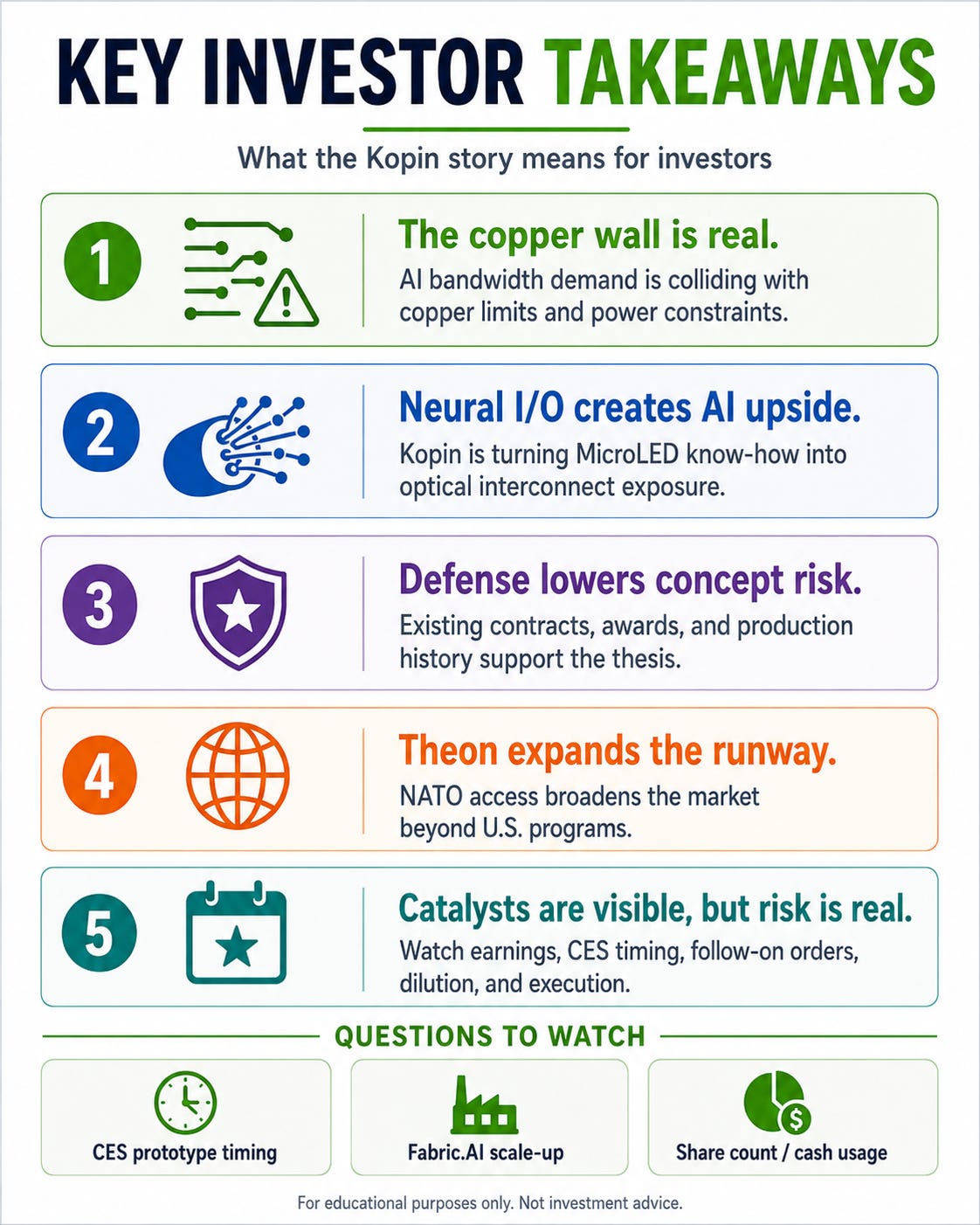
The copper wall is real. The bandwidth constraint is real. The power problem in data centers is real. $KOPN has the only U.S.-built, production-proven MicroLED platform positioned to solve all three. The stock ran from under $3 to $6.45 in six weeks, then pulled back. The next catalysts, Q2 earnings August 4, the CES prototype unveil, and Fabric.AI development milestones, are all ahead of us. The market hasn’t fully priced what this company is becoming. This is chapter one of a new novel. You want to be reading it before everyone else gets assigned it.
If you found value in this, please restack - it's the single best way to help other investors find Hidden Gems Research before the rest of the market does. Not a subscriber yet? You know what to do.
This newsletter is for educational and informational purposes only. Nothing here is investment advice. Always do your own due diligence and consult a financial professional before making investment decisions. I may hold positions in securities mentioned.
I’ve followed you into Kopin, seems like a good bet long-term. What do you think of ALMU?